
Your cart is currently empty!
Eight Seed Starting Mistakes to Avoid

Get updated by email whenever there’s a new post
I have had many decades of ease with seed starting. We always did the same thing every winter. It wasn’t until recently that I have bumped into some glaring and show-stopping issues. This article humbly highlights the mistakes I’ve made so that you can learn and be on the lookout for these same mistakes. I am firm believer that first-hand, experiential knowledge is the fastest way to grow as a gardener. So, with that in mind, let’s dig in.
Poor Timing
Before you sow your first seeds, you should ask yourself, is this the right time to sow these seeds? Each vegetable has a sweet spot both in terms of germination rates and the conditions it needs post germination to thrive. Sowing spinach and radishes in a 90-degree heat wave is not recommended, nor is direct seeding tomatoes in chilly early spring soils. Seeds that persist in cold, damp soil may rot instead of germinate — and we don’t want that.
While I admittedly tend to sow seeds earlier than most, it comes at a cost. If you cannot provide your plants with ample light and temperature levels for a prolonged period of time before garden-ready, time your sowing so even your tomatoes and peppers are not indoors for more than 6 weeks before planting. For my zone, that would mean sowing them indoors around the end of March. For more seed starting inspiration, check out the updated sowing charts in my new book.
This is a hard thing to balance, as every year brings with it different weather. This year has been very mild so far this spring, and yet I decided to put off my seeds for an extra few weeks. Now, I am feeling behind, but on the flip side, I won’t have to coddle seedlings as long indoors and will be able to send them outside faster.
And with that, comes the opportunity to truly weigh the tradeoffs of starting early indoors with more extraneous tending versus starting later and with a faster transplant date. It’s good to test what you know, and meander through your garden honing your own skills that bring you the most joy. Many believe plants thrive when transplanted younger, and you better believe I am paying attention this season to see if this rings true for me.
Light Placement
I’ll give it to you straight: do not seed start in a windowsill. I don’t care how sunny it is, the plants will suffer and you will be disappointed. Their stems will weaken and you will be left with mediocre starts at best. If you don’t have the space for indoor lights and live in cooler climates where seed starting is paramount to our growing season’s success, find a local organic farmer and buy starts for your tomatoes and peppers from them and skip the indoor seed starting routine, and focus instead on direct sowing your brassicas, beans, corn, potatoes, herbs, and flowers. It will limit what you can grow, but what you can grow will thrive.
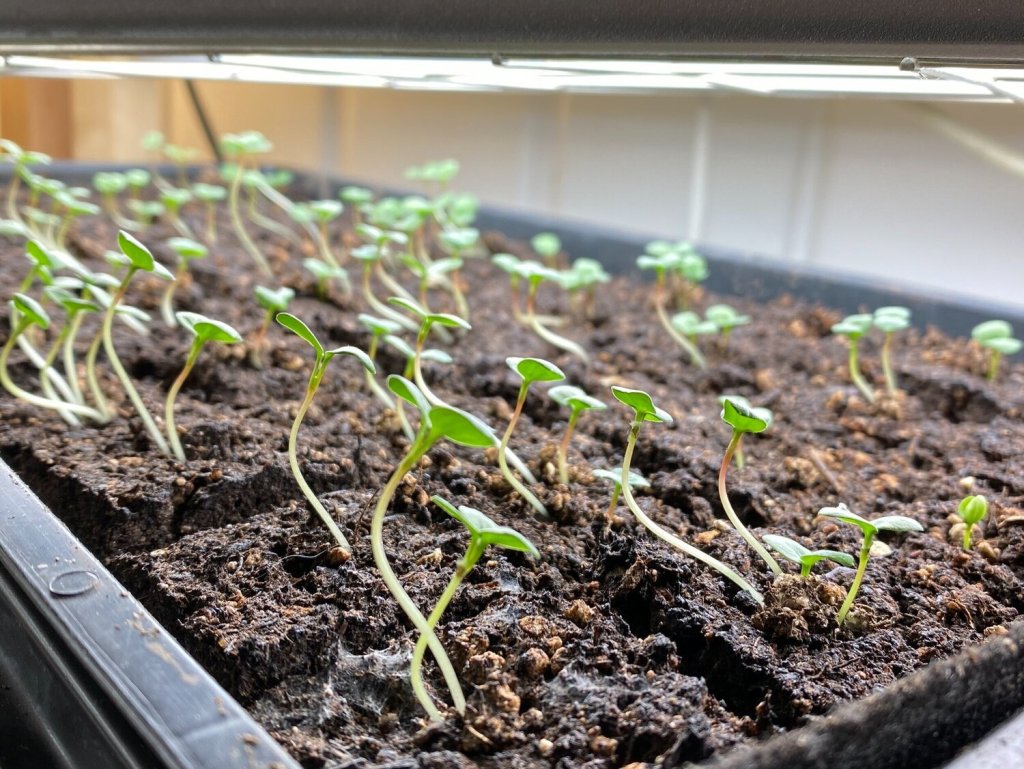
Even with lights, if you don’t keep your plants close enough, the seedlings will naturally lengthen their “spine” (stem) and reach for the light. This is an irreversible process, and one that can and should be avoided by proper light placement relative to your plants, depending on the lights you use. LEDs need to be farther away from your plants than fluorescents, and we continue to experiment with switching to LEDs as our fluorescent lights wear out. There’s no perfect system, except one where the light distance eliminates plants need to stretch out and get leggy.
More on lights can be found on a previous blog post.
Soil Sagas
The crux of seed starting is what is going on in your soil medium. The type of soil you use, its porosity (how much air space is between the particles), and its nutrient density all impact your seeds’ ability to germinate. This lesson has been handed to me two years in a row in two very different ways, and here’s what I’ve learned.
Wet Soil
Plants need water, right? Yes, to a point. I have been surprised to learn and read that many plants need much less water than we think to sprout, peppers and turmeric are included in these literary epiphanies I recently had. If soil is too wet, it is also not breathing.

Too wet and soggy leads to stagnant growth weeks after germination. These pepper leaves even turned yellow and brown due to the excessive water and lack of breathing room below ground. The hardest thing is that this symptom does not appear until well after the soggy bottoms caused harm to the tender seedlings.
Plants are living, breathing organisms from the moment they germinate. If their roots emerge into soggy soil, there’s no air in the soil in which to breath. Instead, they are basically under water. And they suffocate and, worst case, subsequently rot.
You can remediate wet soil with heat and fans and time. A lot of time. We had overwatered peppers last winter and it was weeks of stress but by August there was no difference between my healthy seedlings and the ones that suffered from overwatering and stunted growth at a young age.
Wet soil is often a symptom of another issue with your soil, so read on.
Dense Soil
Following with the young root discussion, they need open, porous soil to thrive. If your soil is dense, the fine young roots won’t be able to navigate the soil medium and this will also result in stress and stunted growth. Your soil will also not drain as well, leaving the blocks wet for longer and thus potentially stressing out those feathery young roots.

These are some of my heartbreaker soil blocks of 2021: nutrient dense soil led to poor germination and failure to thrive.
Dense soil and saturated soil go hand in hand in my experience. If you mix your own seed starting mixture like we do, be sure you have enough perlite or vermiculite to keep the mixture light.
Cold Soil
Temperature is one of the biggest keys to seed starting. If you don’t already use seedling mats to aide in germination, stop what you are doing and invest in them. Plants can germinate over a wide temperature range, but there are ideal ranges for different types of vegetables, and generally speaking, 70-80 is the sweet spot for almost all garden vegetables.
A heat mat removes this issue from your seed starting woes, and we would never try to start vegetables indoors without our heat mats.
Too Rich
The single biggest lesson of the 2021 growing season so far has been my seed starting failure. It involved adding our slow release organic fertilizer into our soil block recipe, a tried and true seed starting mixture that I use for ALL our seed starting needs, not just soil blocks.
I am still working to unravel all that this did to our soil blocks, but I believe it was a combination of the slow release organic fertilizer starting to break down in the warm soil combined with becoming heavier and denser than my normal block recipe (without the added fertilizer), which led to soggy, heavy, and very rich soil. There are probably microbiological factors as play, including nutrient availability and soil microorganism activity that created an inhospitable environment for the seeds to thrive.
Many of the seeds either germinated and then froze, only putting out first leaves, or got stuck right after germination, such as the few peppers and tomatoes that did actually manage, miraculously, to germinate. They had a will to live, I just did not give them the right home in which to thrive.
While this was a complete failure, I am grateful for this lesson, as we had never tried to add fertilizer to our soil blocks from the onset. Now we know that less is more, and that our soil block recipe need not be changed ever again. The soil blocks are headed to the compost bin and will be added to our future garden beds.
The Swift Transplant
The hardest thing to do with indoor seedlings is to wait. And wait. And wait until they hare acclimatized to real sunlight. Our super bright glow from inside our house dims in comparison to even a cloudy day. Take the time you need to properly harden off your seedlings. This process slowly adds full-strength sunlight each day for about a week to 10 days for every single plant that is started indoors. If you try to hasten this process by throwing things out into the garden too soon, you will be cursed with sunscald — plant sunburn — which sets the plants back a few days or more, depending on the size of the seedling.
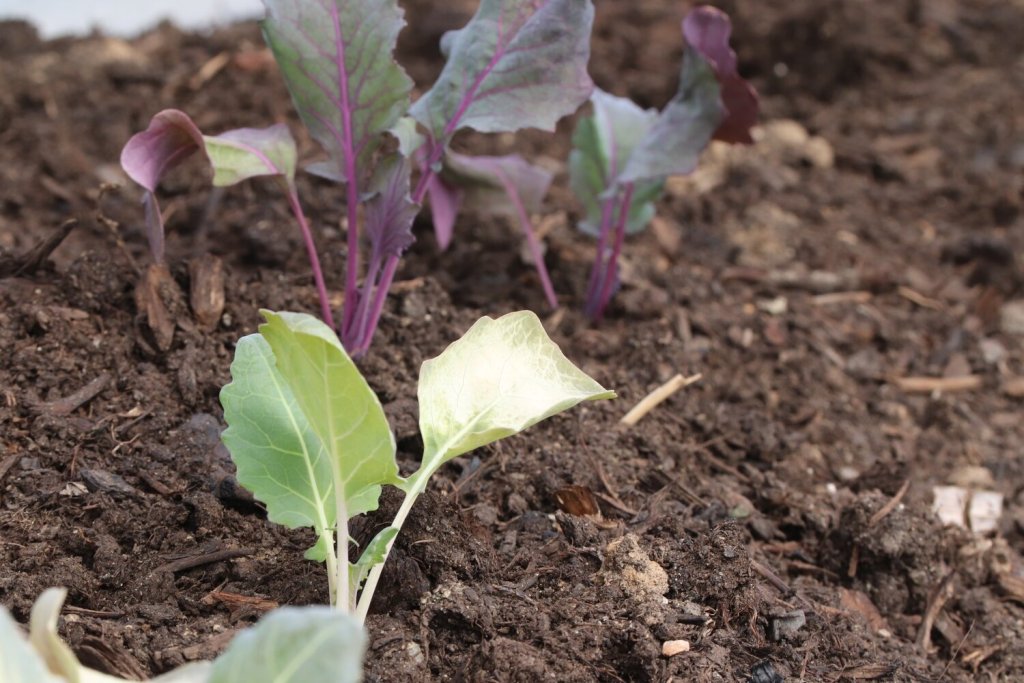
Sunscald in plants looks like this: leaves turn white several days after the event. There’s nothing to do at this point but to buckle in for the ride and hope for a full recovery.
Truth be told, this does happen to some of our brassica seedlings every spring, despite my best efforts to take it easy and not rush things. However, it is a blip on their lifespan and they come back with new, healthy leaves within the week. I’m not encouraging you to follow my lead, just letting you know that our starts always rebound from it.
The Goldilocks Soil
So, do I have it figured out now? Yes, and in fact I already did.
- Soils need to be loose.
- If you desire, amend with compost, but not slow-release organic fertilizer.
- Keep the soil moist but not wet, best achieved by watering passively from below.
- Soil temperatures should be at least 75 degrees to hasten germination of all vegetable seeds. Keep the starts on heat until at least the first true leaves appear.
The thing was, I changed something without testing it first. And I just dove right in with about 200 seeds and 150 soil blocks; my confidence was met with massive disappointment this time around. While that’s not always the case, it is a cautionary tale. In hindsight, I should have re-read my article Growing Strong Healthy Vegetable Starts From Seed.
Failing Fast
So if you want to try something new, don’t invest your entire grow space to it — it is a risky proposition and while it might work out, you don’t want to be in the precarious position I was in having to start all over and having lost over a week of germination and growth.
Also, somewhat contradictory, go ahead and try new things. Because these failures are the fastest way to grow. I would have never known just how dubious adding slow-release fertilizer could be to seed starting until I had this experience.
You might also like:


Get updated by email whenever there’s a new post
Comments
If you’re a subscriber, you can discuss this post in the forums
Leave a Reply