
Your cart is currently empty!
Growing A Resilient Garden

Get updated by email whenever there’s a new post
The climate is changing, and our gardens are some of the first responders. Insect populations are doing crazy things already this growing season, and it reminded me that sharing how I approach building our garden to be climate resilient is a topic deserving of some attention here. So this month’s guide is a brain dump of all the ways I approaching gardening from planting, replanting, unplanting, and playing in the garden to help build a garden that is robust and resilient to the changing climate.
How the Climate is Changing
Here in Minnesota, we are seeing many more high wind days. This uptick in wind events became noticeable about four years ago and hasn’t let up. Even as I write this because of winds and dry conditions we have fire alerts in our area (no burn advisories, etc) which was not normal even 5 years ago.
As if wind wasn’t hard enough, toppling plants and sometimes even killing them — I lost a few, full grown nasturtiums last summer due to high winds — we also seem to be in a feast or famine pattern with rain, and have been since about 2019. First it was soaking rains, unrelenting rains, rains that flooded our front yard. Then the drought arrived during covid in 2020, and we’ve not had a great, reliable summer of consistent rains since then.
The other thing that we all experienced in the US was a “redistricting” of our plant zones a few years ago. This was a big deal for some – many, I presume – and at first glance a warmer plant zone might mean a peach tree is now within reach. But how we approach it is still plant on the side of the polar vortex, the colder zone, because it does seem that with the wind and drought and occasional flash flood, extreme cold snaps will continue to dip further south than historically.
So on paper, I think we are now a zone 4b, but I still think of us as a zone 4a. And honestly, when we plant perennials, we like them to be zone 3 hardy, especially our fruit trees.
It sounds onerous, overwhelming, and out of our control. Because it is. But what is in our control is how, when and what we plant. And also how we make changes to things that are challenging now, or challenges to come. And that’s what I want to focus on.
What we can do about it
It’s a hard topic to delve into because the climate crisis is daunting, and honestly I’m feeling as battered as my bok choy looks right now, but we have control over our landscapes and have the power to shift focus and find opportunities in numerous ways.
Rethink perennial Edibles
I mentioned this above, and it’s worth diving into further. Perennial fruits are a bigger investment in money, time and space than your tomatoes or beans. They require extra tending and fretting (hello, blueberries!) and more inputs to produce food. But, when they do start producing, boy do you feel like a rock star!
I’m a firm believer the most climate resilient garden prepares for the coldest weather. Because cold weather is what determines whether a perennial can survive your winter. And a cold snap with snow is not as cold underground as a cold snap without snow (hello, droughts, which also happen in winter here now … cue depressing music).
So when we plan new edible perennials, we choose at least half a zone colder than we are. That is to say, we buy things that are hardy to at least zone 4a (we might now be zone 4b). Better yet, when we selected our pear trees a few years ago, after having lost one to a cold winter, we bought zone 3 hardy pears. This way, our plants won’t succumb to the wobbly polar vortex of future winters, an inevitability we won’t avoid.

Embracing native edible shrubs is another fantastic way to thwart the changing climate and bring resilence to your garden. Elderberries, chokecherries, serviceberries, and more are all adapted to our northern climate. They can be added as more formal plantings. Common elderberry is a fast-growing, bird-loving, tall shrub that will provide a privacy hedge upwards of 10′ in a few years. It’s also medicinal and the flowers can be used too. I love that it brought a flock of cedar waxwings to our property.
Plant Native Flowers
This is a topic in my book as well as something we deeply believe in: rely on your historically endemic plant species when you consider new plantings/gardens on your property.
For us, this is a slow but steady move to reintroduce native seeds — flowers, sedges, grasses, shrubs — to as many areas of our property as we can. We aren’t completely ditching our lawn but have reduced it dramatically, converting over half an acre to native prairies instead.
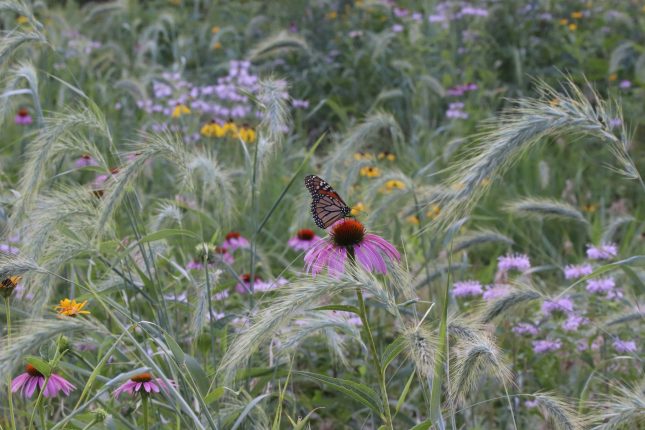
The benefits of planting these species are many: they sequester carbon, are drought tolerant, build soil, attract and provide habitat for native insects whose precipitous decline is alarming, and makes a really beautiful, vibrant, low maintenance garden. This will naturally attract predatory insects to your property, which will feed on various pests. For example, the familiar bluet who I see every summer hunting and consuming asparagus beetle larvae. Or the goldenrod soldier beetles whose grubs hunt other grubs, such as the Japanese beetle. More insects usually means more resilience, and a prairie or other native garden is a great way to enrich your local environment and your life.
Choose pest resistant crops
This is a main focus of my food garden lately: choosing crops that are pest resistant. Now I also grow a LOT of food that is pest susceptible like all my cabbages, broccoli, brussels sprouts, etc. But by and large, I lean on pest resistant foods, foods that for me have low pest and disease pressure. This buffers my harvests with some easy to grow plants that are very low mainentance, including:
- onion
- potato
- corn
- beans, dry and snap
- lettuce
- carrots
- beets
- peanuts
- sweet potato
- sesame
- herbs, especially dill and basil
Plant Diversely
Planting less of something reduces our risk. Think about how devastating it would be if all I grew was tomatoes and my soil was full of spores from septoria leaf spot, which, by the way, I’m convinced it is. Every year I would simply be exacerbating the problem, providing habitat for the spores to proliferate.

By planting my garden in smaller blocks, my risk is greatly minimized. Think about my spring beds this year: I have had a terrible time with my brassicas but my peas, which as noted above are disease resistant, have thrived. My broccoli is a bust but my interplanted iceberg is thriving. My beets are doing well but I have NOT a single kohlrabi, as the few seedlings I planted all shriveled up.
The more diversely we plant — and this includes spreading the plantings out through succession planting — the more chances we give our garden to outwit the weather and pests.
So I guess, slowing down our planting and spacing things out is a great way to garden for this new climate too, something I’m embracing more this year too.
Trial New Varieties
I am a huge proponent of this. Always try a different seed type/variety if you’re unsuccessful at a crop. Don’t give up or think you can’t grow it. Different varieties can make a huge difference in how they grow in your garden.
One of our biggest changes in regard to this was moving away from pole beans to bush beans due to excessive Japanese beetle damage. We left our beloved Fortex pole bean behind after 15 years of reliable bean harvests. It was just a magnet for the beetles and we were tired of all the soap pails of water.
Bush beans were much more reslient to the beetles. My theory is they are lazy in flight and land on the taller things first. They often cling to our dainty asparagus foliage too, which tops out around 6′ tall.
Play with your Seasons
Succession planting is a big part of how I grow a resilient food garden. Especially staggering successions, planting a crop at different times. We currently have 2 sweet corn plantings growing and before too long I’ll plant our third and final sweet corn planting. This gives us corn for longer and also keeps opening up space in the garden to replant all summer long.
Staggering successions can also thwart pest pressure. Take edamame, which is a fun crop to grow and used to be pest free. That is, until the Japanese beetles started to show up.

Japanese beetles also really love soybeans (edamame). After intense pest pressure I tried the easiest change: timing. I changed the sowing to later in the growing season, which greatly reduced pest pressure. Now, instead of planting in late May, I delay planting until late June. The edamame are ripe later in the season, after the height of Japanese beetle foraging. The plants are more productive and less defoliated. It’s an easy change that made a big difference. Less food I attract the beetles with, the fewer grubs will overwinter in our soil.
The Summer pivot
Hopefully you know this is a big part of my gardening mantra: be ruthless and pull out plants that are either not working for you or are done producing or that you’ve satiated yourself with and are needing space for a different crop.
This is especially important during the middle of summer (late July to mid August) here. It’s when I try to complete my canning of pickles to free that space up for fall root crops and quick growing leafy greens. It’s also when I might reset a summer squash planting to curtail the squash vine borers.

Just because you planted something doesn’t mean you have to keep it in your garden until frost. You can reset a bed any day of the growing season. This is a big part of my succession planting strategy, and if you haven’t tried it yet, I encourage you to give it a go this summer!
Pay Attention
At the end of the day, all of this advice can boil down to one key tenet: paying attention. Observe. Spend time in your garden. Know your varieties and think about how you timed them. Play with your sowing schedule and succession planting to try and outwit the timing of pests. Our attention is what we can offer the garden. It’s how we can adapt to the changing climate.

I paid attention one summer and started noticing monarch caterpillars not just on the leaves, but also on the flower buds of milkweed. These are the kinds of lessons waiting for us when we turn our attention to our landcapes, learning things by giving our time and full self to our gardens.


Get updated by email whenever there’s a new post
Comments
If you’re a subscriber, you can discuss this post in the forums
Leave a Reply