Your cart is currently empty!
Direct Seeded Garden Update

Get updated by email whenever there’s a new post
For the past few years I’ve been experimenting with direct seeding more vegetables.
Direct seeding seems like a great solution to reducing my carbon footprint and easing the burden of raising, hardening off, and then transplanting tender seedlings. I am continuing to bend this concept as far as I’m currently comfortable. The biggest challenge for me is how it will affect my seasonality. That is, what will my seasons look like if I move more and more things to direct seeding?
When will my zinnia start flowering? Would I only direct seed basil, making its timing mismatched with my garlic scapes and my massive batches of garlic scape pesto? What are the best-suited vegetables to direct seed, those that give me some breathing room indoors but don’t hamper the diverse summer bounty? These are the kinds of questions I am swirling around as I observe this year’s direct seeded plants grow alongside their indoor-seeded counterparts.
But, direct seeding is not always a slam dunk for gardeners who struggle with cutworms who mow stems down overnight, birds and rodents who will dig up bean and corn seedlings to feed themselves or their young, and so on. I know direct seeding can be a downright impossibility for many people, and I am equally working on thinking that through as I watch my experiments play out across the seasons.
This year, the three main season vegetables I am growing from direct seeding are onions, roma tomatoes, and a red bell pepper. For romas, these are the only roma tomatoes in the garden, so this was a bit of a gamble I took this season, leaning into what I learned the last 2 summers direct seeding tomatoes with great success. This year is a bit cooler, and the tomatoes are reflecting those sub 90 temperatures.
I also grew some spring crops directly seeded as well, but they have all been harvested. They matured about 2 weeks behind my indoor sowed brassicas, and included kohlrabi, tiara cabbage, and cauliflower. My cauliflower was pretty badly foraged by insects, and was wind-blown and didn’t get nearly as large as last year’s fall cauliflower, but it worked. Worked enough for me to strongly consider continuing that trend for next spring.
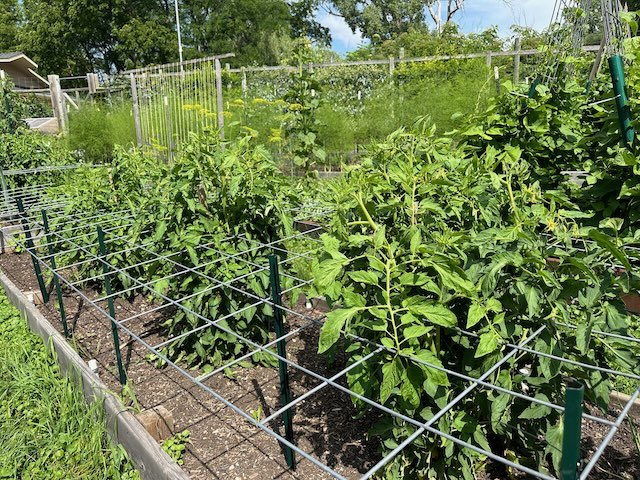
The tomatoes are doing well, but I had slow germination. As a result, the planting looks like a staggered succession: some have fruit set while others are a good 12” shorter and just starting to flower. I expect this to equate to smaller harvests over a longer time, which means, I think, more time processing. We will see how it goes, but it does look like it might come into season right after I get home from getting our oldest settled into college in Oregon.
I am growing onions as a three-way experiment: indoor sowed, direct seeded uncovered, and direct seeded covered. The covered ones were in the same low tunnel where I planted our spring peas, and germinated about a week or so ahead of the uncovered onions.
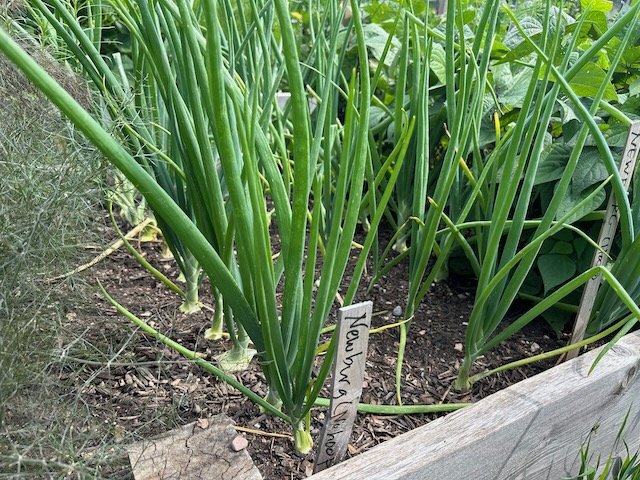
Unsurprisingly, the onions I transplanted as healthy seedlings in late April, about a week after the others germinated, are doing tremendously well and will be flopping over before long. This is my gold standard for onion growing — and for succession planting. I rely on this bed for transplanting napa cabbage and kohlrabi in August, as well as direct seeding some of my winter radishes like daikon and watermelon radish.
Some onions are as large a softballs, though let’s be honest: how many dishes besides homemade salsa or ketchup require a 2-3 lb onion? But will the later plantings produce onions large enough in time for curing? They are bulbing, responding to our long day length (I always grow long-day onions), so that is a good sign
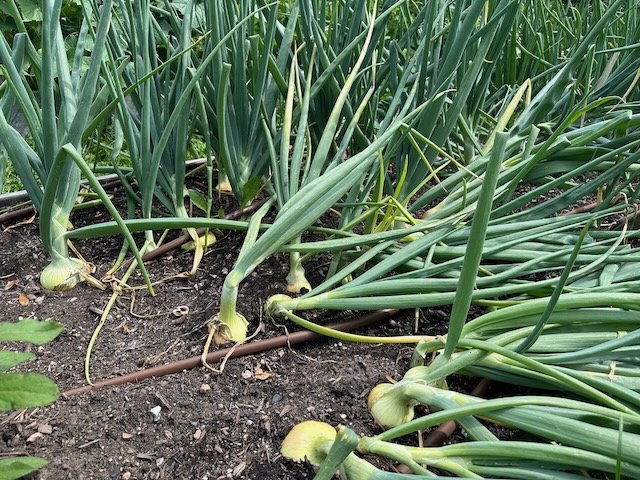
The indoor sowed (in late February) and transplanted onions are many many weeks ahead of the direct seeded onions.
So far, the uncovered and covered onions seem to growing at about a similar rate; I don’t see a large size difference, but they are about a month behind. It will be interesting to see if they store longer, as they won’t be harvested until later in August, or if their storage time is about the same as the ones that are harvested sooner.
On a whim, I decided to start more bell peppers in April, April 11 to be exact. This is the latest I’ve ever sowed bell peppers indoors. Then, about 2 weeks later, on April 24, I direct seeded the same variety, Wisconsin Lakes, in our cold frame. The direct-seeded cold frame pepper germinated in about 2 weeks in the cold frame, which honestly was pretty good. I transplanted it into the pepper bed in late May, and it was a tiny seedling at that time. It has been slowly gaining height on the indoor sown seedlings. Currently, the direct seeded plant has open flowers while the indoor sown plants have fruit set already.
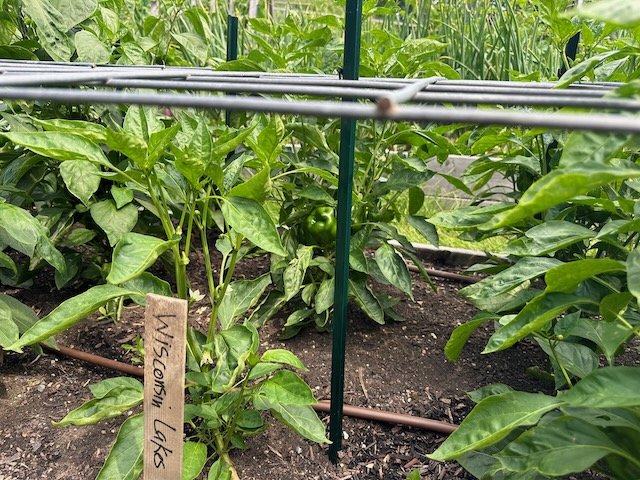
Front: direct-seeded pepper with open flower. Behind: indoor sowed pepper with fruit set already. I’m rooting for the direct-seeded pepper to prove me right, that direct sowing fast maturing peppers is possible here.
The big question with these peppers is will they produce ripe peppers before the days grow cooler? I’m anticipating September peppers on this plant, but September can be a wild ride — hot and humid or cool and rainy. And I anticipate much of this trial’s success to hinge on the climate in late summer, which wildly varies from season to season.
All that being said, I can see potential in direct seeding some peppers, continuing to direct seed my roma tomatoes, and might start to grow more of my onions direct seeded if we can make our succession planting needs align with the later harvests.
I’ve also just recently direct seeded some bok choy, Spigariello broccoli, Di Ciccio broccoli, stem broccoli, iceberg lettuce, beets, and tiara green cabbage. These are all fall vegetables I almost always indoor sow and transplant. Bok choy has been the one breakthrough over the last 3 years that, along with kohlrabi, has helped me deconstruct my entrenched belief that indoor seed starting is supreme for growing a fall garden. I am thinking I’m a little late for the broccoli, but these are fast-maturing varieties so they may produce for us in late September. The bok choy, unsurprisingly, germinated in under 3 days!
I am excited to continue to study, explore, and assess all the ways direct seeding can help me grow as a gardener. It’s all about considering what vegetables we need in season when, and how we can coordinate those needs in combination with indoor seed starting and direct seeding. The biggest lifts for me are in August and September when I’m reaching for bushels of tomatoes and pounds of onions for my salsas and ketchup. If it’s possible to direct seed more, and I can manage pest pressure easily, it feels like the right direction to take the garden, not entirely, but in key areas where we have flexibility and space to direct seed our succession plantings.


Get updated by email whenever there’s a new post
Comments
If you’re a subscriber, you can discuss this post in the forums
Leave a Reply