
Your cart is currently empty!
End of Season Garden Guide

Get updated by email whenever there’s a new post
How we close out our growing season is as important as how we start it. In fact, it determines when we can start it in many ways, particularly if you live in a climate where your ground freezes in deep winter like we do here. (Who am I kidding, our ground freezes solid in fall and remains frozen until spring.)
Joking aside, what we do with our diminishing sunlight and working hours matters immensely. The top priorities for me this time of year are removing diseased plant material and dealing with them in an appropriate way and disinfecting my trellises against any lingering fungal spores said diseases left on our trellises. Lastly, and equally important, I try to get as many beds as possible ready for spring planting as possible — this allows my springtime to be focused on tending to hardening off seedlings and sowing more plants as needed both indoors and direct seeding.
If I didn’t take as much time to clean up and prepare my raised beds in fall as I do, more of spring would be spent cleaning up debris from last fall and hauling in compost, resulting in later planting dates. This has a cascade effect as it will push out my earliest harvests and then limit my options for succession planting come July or August when those first seeds/plants mature.
So let’s get into my 3 areas of focus I hope you’ll all adopt or consider as part of your fall garden routine.
How to Remove your Spent Plants
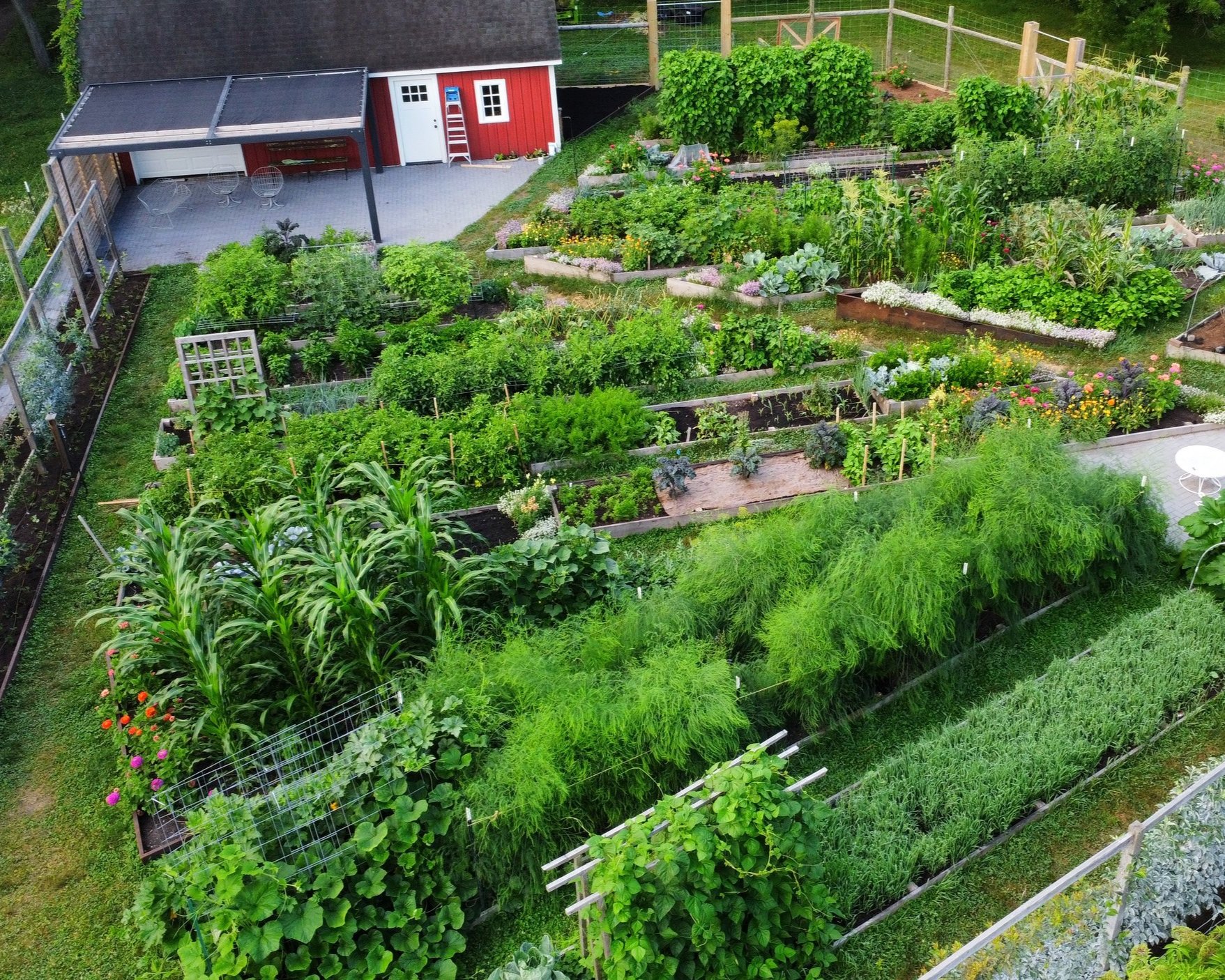
I hope the idea of not tilling and minimal soil disturbance are things that I’ve familiarized you with over the course of my videos and stories. We don’t till and we try to keep as many plant roots in our beds as possible. Sometimes, yes, I go for the thrill of yanking a plant out, but a true “No Dig” garden always cuts plants at the base and keeps the roots in place and intact to feed the soil microbiome.
If you can control yourself in the heat of the moment, I highly recommend you do this, even for things like corn. We leave our corn stalk remnants in place for several seasons and by the time we take them out, it’s really just the material above ground that’s left. It’s a good feeling to know we are supporting our soil that so generously supports us.
You can read more about this topic in this Blog Post from last fall.
What to Do with all Your Plant Material
Not all plant material in the garden is treated the same. The biggest area of focus (read: concern) is any diseased plants. The most important diseases for me include foliar tomato diseases and foliar cucurbit diseases. They both spread by (microscopic) spores, often propelling themselves out of the little sclerotic dots on the leaves out onto other plants and likely also right into the soil below.
One of the main reasons we crop rotate is exactly this reason: to separate our host plant (say, tomatoes) from the lingering spores (say, Septoria leaf spot) by moving them to a different raised bed each year, thus making it harder for the spores to reach their host plant, the thing they need to successfully reproduce and live on.
The reality is that spores can persist in our soil, yes, even my very frozen and cold soil, for years. That’s right. Up to five years, to be exact. So how we deal with this season’s diseased plant material is imperative for the health of next year’s garden.
And many years after that too.
I recommend you take care of your diseased plant material in one of four ways this fall:
- Compost on-site. If you do this, your compost either needs to get hot enough to kill pathogens (131-170F for 15 consecutive days, turning the pile a handful of times during this process), OR you need to let it passively compost for those five years I mentioned above. Your choice. I realize neither is an easy ask. Here’s an article from the Rodale Institute on Composting: https://rodaleinstitute.org/science/articles/compost-management-in-certified-organic-operations/
- Bury the diseased plant material to mitigate spores spreading by wind or rain. If you do this, just be careful not to disturb nearby tree roots. This seems like a viable and logical option for folks who want to keep the material on their land in a way that utilizes the biomass, a way of maintaining a closed-loop system.
- Compost via your municipal compost. Most cities and even many rural towns now have industrial composting options. This is a great place for your diseased plant material because their systems get hot enough to kill pathogens, so they won’t spread further.
- Your municipal trash or a burn pile is the last option for these wary plants. Use these alternatives if they feel like your best option for your home landscape.
What about “Leave the Leaves”?
Now that we’ve covered diseased plant material, you may be wondering if you can leave the rest of it to stand all winter long. Yes, you sure can. As discussed above, this will delay your spring garden season a bit. I know we hear a lot these days about leaving the leaves and waiting to cut down perennials until spring. And that’s also true too. The reality is that it’s practically implausible that beneficial insects such as native bees have burrowed into my tomato, kale, or brussels sprouts stems. Plant material to leave through winter is hollow-stemmed perennials, the likes of joe pye weed and native grasses.
This is where our prairie plays a key role in our food garden, to supplement it so that when I give the garden a good clean up in fall I am still leaving a lot of plant material standing everywhere else on our property, thus providing critical habitat while also getting the most out of my growing season.
Now, if you prefer to clean up in spring, or if your winter is mild then it might make sense for you to keep your disease-free frost tolerant flowers and brassicas standing to enjoy. And, because your climate is milder, it’s likely you’d be able to clean that up come late February when it’s time to start direct seeding your earliest spring veggies.
Like with most options I give you, I hope you take or leave this as it suits your growing style, while armed with the pros and cons of each approach.
The Importance of Disinfecting Trellises
Besides the actual plant material, spores can lie dormant on both metal and wooden structures for years, just like they can on our soil surface. So in addition to removing the diseased plant material, the next step we’ve started doing here is taking the time to disinfect our trellises before we take them down in the fall. (Well, mostly, some have already come down that need to be disinfected.)
For this method, we have chosen 3% hydrogen peroxide. (A 10% bleach solution is an alternative, but I don’t like to use it in the garden for many reasons, including that it doesn’t breakdown like peroxide and it can damage metal, among other things.)
You can buy hydrogen peroxide in bulk, like a 1-gallon container, online via the jeff bezos empire, or you can purchase it in quarts at a pharmacy for a similar price (about $2/quart or $8/gallon). We use a few gallons each year during our disinfecting.
It’s as easy as pouring hydrogen peroxide into a spray bottle or backpack-type sprayer and generously spraying the entire surface. Hydrogen peroxide needs to be in contact with the metal or wood for 10 minutes to be effective. This is a great activity for late afternoon or early evening. After they are fully dry, the next day, we will take them down and store them for the winter. I like to leave my trellises in place until this task is complete, which makes this work much easier and ergonomic.
This is definitely a task you could put off until spring, but that’s just that much more time you’re allowing the spores to hang out on your property and in your garden. Seize the day, my gardening friends.
Protecting Your Soil
As important is how we tend to our soil in the off-season. For some, they like to plant cover crops that will die with a hard freeze. Since I push my garden so hard all season with succession planting, we don’t feasibly have time for fall cover crops here. Again, if you’re in a climate where the soils don’t freeze, winter cover crops are a great idea too.
Instead of cover cropping, we cover our soil with a generous amount of compost — I always add a minimum of 2” (5 cm) of compost directly on top of the beds in fall (and for some beds, it happens in spring). Laid directly on top of an empty garden bed, this is for me the equivalent of adding straw or leaf mulch to my beds. The soil that has been feeding our plants all summer is chock full of life, and I want to protect it this winter, and for that I use compost. It’s a fabulous way to add more nutrients to your soil and for both sandy or heavy soils, adding a generous amount of compost annually is one of the best things you can do to build your soils.
I follow the steps above before adding the compost, usually: I take all plant material out, sterilize my panels if present, take them down, and then finally, the compost is added on top. This is the second to last step in preparing beds for spring, and it’s one of the best things you can do to get the earliest and easiest start to your growing season next year. (The last step I’ll share next week, which is how to get low tunnels set up in fall for late winter so they’re in place and ready to go as well).
I know for many we are tired this time of year, but with the rapidly decreasing daylengths — we’re losing 2 minutes a day — I find these tasks even more urgent. I have very little time to get these tasks done except on the weekend (or weekdays if my schedule allows). Once dinner’s dishes are cleaned up it’s dark out and time to unwind — a very different season than summer when sometimes I wait until after dinner to work because it’s too hot.
You might also like:


Get updated by email whenever there’s a new post
Comments
If you’re a subscriber, you can discuss this post in the forums
Leave a Reply