
Your cart is currently empty!
Establishing a Fruit Orchard

Get updated by email whenever there’s a new post
It’s not as simple as just digging up a little earth and tossing a tomato plant in the ground. Orchards take more time, more planning, and more resources to establish than an annual flower or vegetable garden. But the rewards of fruit over many years is worth the head-scratching antics that are needed to set you up for success.

This post will go over what I see as the essential steps you need to take to prepare yourself and your site for a future fruit tree orchard. This post will focus mostly on apples, but the rules apply to all fruit: you’ll need to consider your site and soils carefully, ensure cross-pollination, and decide what kind of rootstock and purchase you want to make.
Site Location
Fruit trees, like almost all food, love sunlight. And because they are trees, be sure to plant them far away from any drip lines from other nearby trees. Give them the full overstory of the area, thus reducing underground competition with other trees or shrubs.
Another important factor related to location is drainage. Fruit trees do not tolerate wet feet, the term of endearment for soggy, waterlogged or poorly draining soils. The easiest way to remedy this is to ensure your location has a slight slope so the water won’t stagnate after heavy rains. This is likely a non-issue if you have sandy soils and more of a perennial thorn if your soils are heavy clay (like ours).
Soil Considerations
Soil drainage is equally important, and should drain well. Consider doing a soil test to understand your pH and adjust if needed (use of lime or sulfur can raise or lower your pH, respectively). Plan to add organic matter to the soil annually. We top dress annually with a few inches of fresh compost.
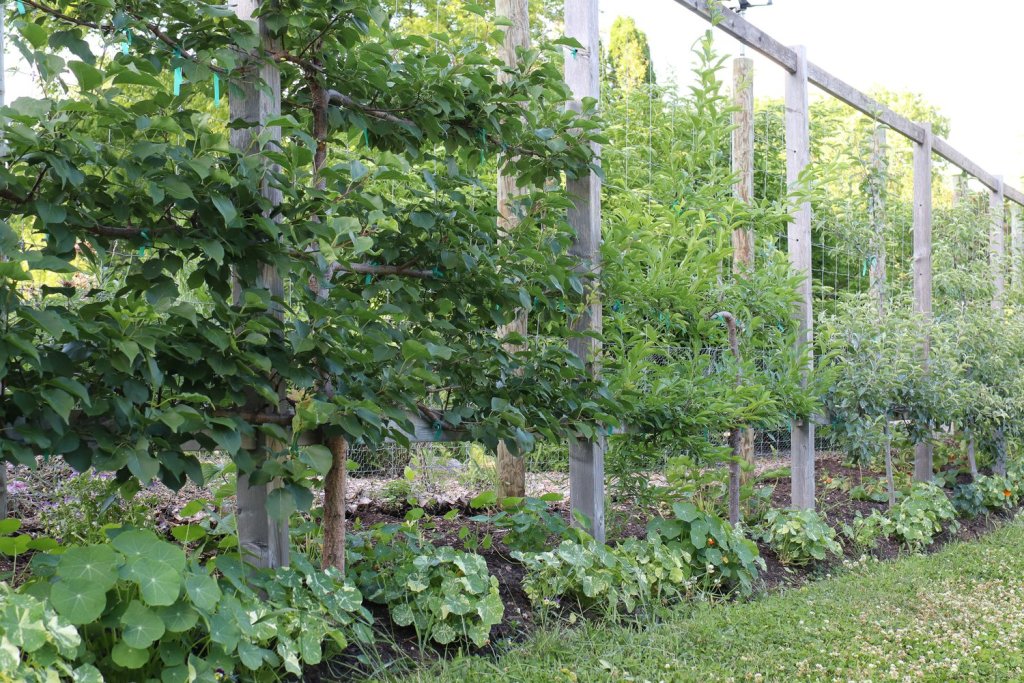
It’s recommended to plant your trees with no more than 30% compost in the planting hole along with your native soil (assuming it’s not super sandy or super heavy clay) so the roots don’t stop growing once they hit the edge of the amended soil. Roots sense the change of soil type and if the native soil is much heavier roots have been known to just circle around the comfy, amended soil and avoid the tougher life, basically being root bound even though they are in the ground.
You can plant directly into your native soil and amended lightly, adding some slow release organic fertilizer and compost. This is what we did for all our trees and they are all growing really well. Our native soil is heavy clay here.
Cross-pollination & Choosing Varieties
Apple trees need another variety to successfully cross-pollinate its fruit.
The easiest way to achieve this is through crabapples. If you live in an urban or suburban setting, it’s likely that your neighborhood already has enough nearby crabapples for your future apple tree. In this case, you could get away with planting as single tree in your yard and have successful cross-pollination. If you’re in a more rural setting and you’re planning to grow many apple trees, you need to consider pairing your varieties by the timing of their flowering so that the bees will have pollen for successful cross-pollination.

This is a tale of succession planting — but we’re looking at the succession of pollen across our spring weeks. Apple varieties are categorized by when they flower. Early and Late season flowering trees are more rare; mid-season apple fruiting is the largest category. So if you choose your varieties carefully by looking at when they flower, you should be fine.
I think our Haralson, the largest and most prolific producer of flowers, is probably our best pollinator for the majority of the orchard. Other trees that flower at the same time include our Snowsweet, and William’s Pride. We have a younger Zestar!, but it hasn’t produced fruit yet — interestingly a William’s Pride is listed as a good pollinator for that but not a Haraslon.
We have other apple varieties too, but they haven’t flowered yet because they are younger trees or were grafted onto other trees (a topic for another time). However I saw on this list that the Haralson is a good pollinator of most of our apple varieties. here.
Here’s a link to a really helpful fruit tree pollinator cross-check from Orange Pippin. It works for apples, pears, plums, and more. You type in the tree you want to grow and it lists all the trees that it can cross-pollinate with.
Succession Planting
This is really important in choosing your fruit trees. You need to consider when the fruit will be in season. Some fruit trees can easily produce over 150 pounds of fruit! So ideally, in our world, you space that out across a month or more. Otherwise, it’s possible you will be overrun with fruit in a really short window of time, making this glorious notion of fresh homegrown fruit more of a headache than a joy.
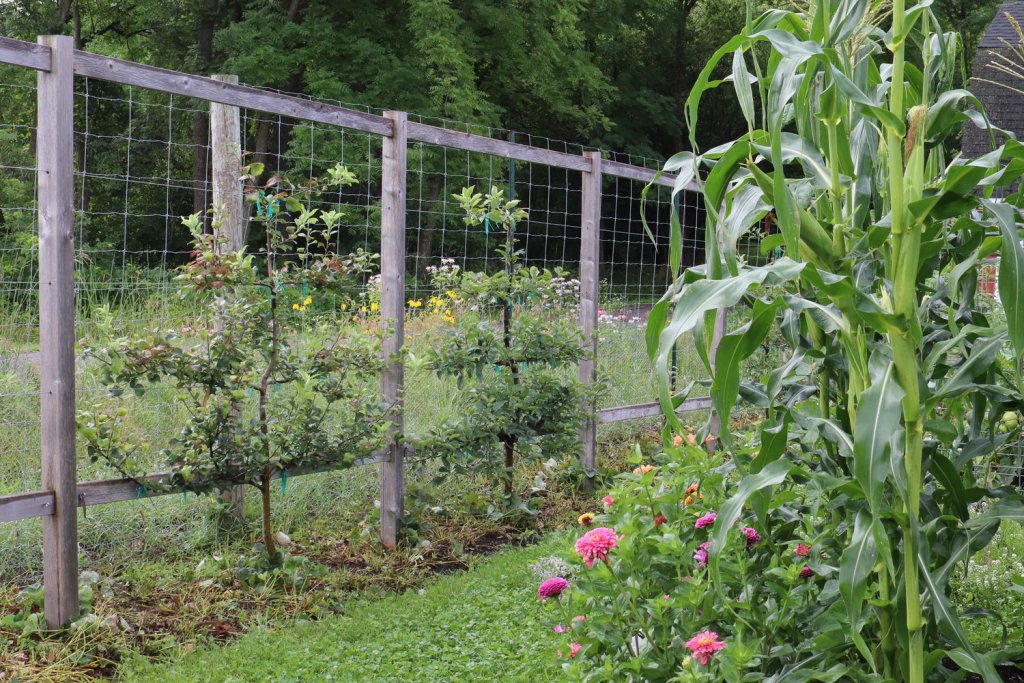
Here’s how our varieties produce across the season. Now that I’m writing this out I’m thinking to myself our main (mid) season will one day be overflowing, as astutely noted by our oldest this summer when he witnessed how many apples we pulled off 2 trees and asked us how many apple trees we had total.
Our Varieties
Apples
William’s Pride -mid- to late August
Zestar! – late august to early September
Honeycrisp – mid-September – mid-October (hasn’t produced and it’s 8 years old; don’t recommend growing one)
Haralson – late September – early October
Mountain Rose – late September – early October
Calypso – late September – early October
St Edmund’s Russet* – late September – early October
Triumph* – late September – early October
Snowsweet – mid to late October
Black Oxford* – mid-October
Gold Rush – late October – November (stores for 6-7 months)
*Grafted onto existing trees
Apricot
Brookcot
Pears
Luscious – mid- to late September
Gourmet* – mid- to late September
Flemish Beauty – late September
Celine – early October
Plums
Black Ice – early August
Toka (Bubble Gum) – late August
*Grafted onto Luscious
Bare Root or Potted Tree
Like with buying seeds rather than nursery-bought starts, you will have the greatest access to variety when you order fruit trees bare root. It also saves you money, and especially for training/pruning into espalier, there’s no reason to buy a potted plant 3x the cost of a bare root.
We purchase bare root trees, unless we’ve lost a tree and want to replace one quickly. But even then, we end up losing an entire year because the buds inevitably don’t align with our espalier needs.
Further down the line once you get a tree growing, you can try your hand at grafting — this is adding new branches to your tree that are different varieties. Several of our fruit trees are now grafted with two varieties sharing the same root system. It’s a fun way to increase diversity in the orchard.
Plant Spacing & Rootstock
How you layout your orchard depends on what type of trees you buy. You want more than enough room so the canopies remain open, meaning they don’t touch at maturity. For our espalier trees, we control the canopies pretty intensively so we space them 8’ apart for dwarf rootstock, which are trees that mature to 8’ tall. But if they were open grown, we would have spaced them 10 or 12’ apart on center.
Our Haralson and Gold Rush are both semi-dwarf, open grown trees and they are both in their own beds that are about 15’ square (technically, they are triangular beds, but they are larger than their canopy will be at maturity).
All apple trees are grafted onto rootstock. Rootstock determines how tall the tree grows, among other things. Rootstock plays an outsize role in the overall vigor of the variety too.
Semi-dwarf rootstock is pretty common. These trees mature around 12 feet tall, though unchecked will grow much taller than that (as seen by our first espalier that the new owner doesn’t maintain and it’s easily 16’ tall up the side of the house). You will need to space them about 12’ apart if open grown, or plant them on 12’ long trellises if going the espalier route.
Dwarf rootstock is great for smaller homesteads as the trees only mature to about 8’ tall. Easier to fit more trees in, easier to manage pests and harvest at this smaller height, but of course there are downsides too. You have to be more active with thinning out your fruit otherwise risk breaking branches. And these trees require staking, so while ideal for espalier, they require more work due to shallow root systems for open grown trees. They are what we grow here as espalier trees, and the trellis gives their shallow roots the stability they need to thrive.
If you want to espalier, dwarf rootstock is the way to go. If you have ample space and want a beautiful classic orchard look that will require a harvesting ladder someday, then I’d definitely choose semi-dwarf trees. We have some of each here, two open-grown semi-dwarf apples and about 12 espalier fruit trees (most of which are apples too).
Trellising for Espalier Orchards
Before those holes are dug for your trees, it’s a great idea to get your trellis system set up. We have used several different methods for our trees over the decades. In our current garden we used the extra high tensile wire that was for our corner posts of the deer fence and some turnbuckles. It’s more or less invisible and we love that. It’s connected to 4×4 posts that are 8’ tall.
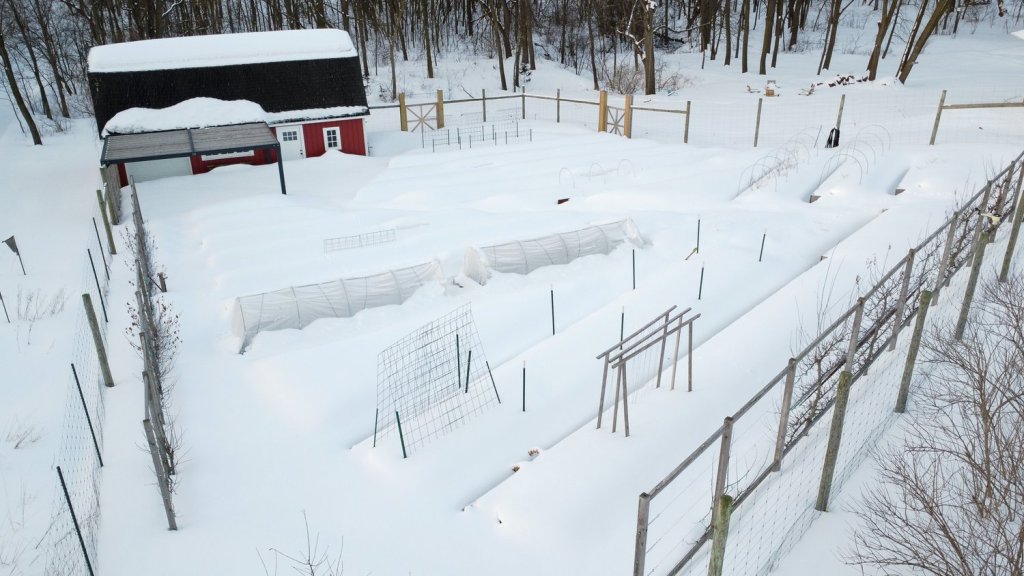
For this orchard, we intentionally left 30” behind the trees so we could get behind them to work and prevent deer from reaching through the deer fence for any snacks. We also grow strawberries underneath our fruit trees and that space behind is key to our strawberry productivity.
You can also use bamboo, rebar, or other materials — you could even use a fence and attach something to it. We did this at our last house. John used metal tubing and screwed it to the fence. It was very industrial and looked great!
Pest Pressure
Voles sometimes like to girdle trees during the hungry gap in winter. Deer will definitely browse and damage fruit trees. Protection from pests is highly recommended. Most (all?) commercial orchards are protected by deer fence. Even some extra apple trees we have planted outside our main garden have been individually caged off with extra deer fence and some t-posts (at 6’ high because it’s a smaller area and the deer can’t jump inside the cage).
Further Reading
I highly recommend the book The Apple Grower by Michael Phillips. (affiliate link to my Amazon storefront)
I hope this post gets you thinking about what you will need for your future orchard! I’m sure I left some details out, so please leave comments below and we can keep the discussion going.


Get updated by email whenever there’s a new post
Comments
If you’re a subscriber, you can discuss this post in the forums
Leave a Reply