
Your cart is currently empty!
Favorite Varieties: Potatoes
Get updated by email whenever there’s a new post
Oh the mighty potato. It’s hard to remember a time when we didn’t grow them, but it really is rather recently in our long history of growing food.
We did grow them our third year growing food, in 2001, but we had to co-opt other land to get them planted. And as I recall, neighbors went and dug some up before they were ready, but that’s a whole other story. Oh, and my husband lost his wedding band while hilling them and our good friend and gardening guru at that time came biking over with a headlamp and helped find it among the rows of mounded taters.
For some reason, when we moved to Minneapolis we didn’t really consider growing them again. And we didn’t plant them until we moved out to this oversized exurban garden in 2017. And of course, that first growing season was fraught with disease as the soil was new, the nearby black walnut trees had just been removed, and we were in transition.

Potatoes add a gorgeous pop of color midway through their season, and I always marvel at how their ephemeral blooms play with their surrounding colors and textures. It’s possible, but quite uncommon, to grow potatoes from their true seeds that form from these flowers.
We have trialed over 12 varieties over the past 8 years. This past season, we grew 8 varieties across the equivalent of 3, 4’x8’ raised beds. And I fully recognize that’s not a normal garden size, so I narrowed our favorites down into Top 3, Honorable Mentions, and Tried to Love Them. I will grow all the potatoes listed except those in the tried to love them category, as those we really did try to make work for us, growing them multiple years, but it just wasn’t worth the space due to repeated issues.

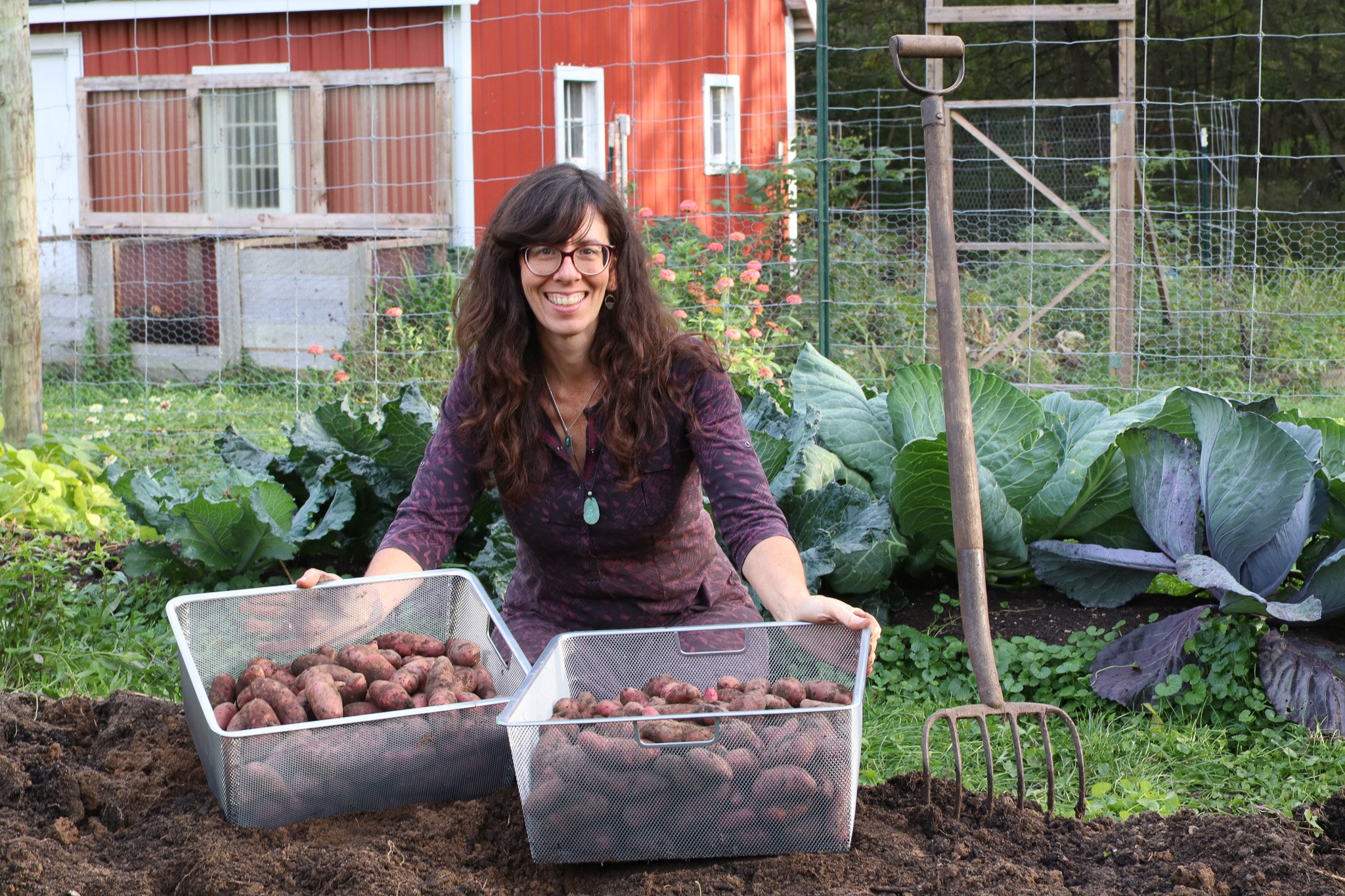
Our first growing season with our expanded garden meant seeing how much more we could stretch our potato yields. We gfewa bout 170 pounds that year, and were really impressed with the Burbank Russet and Huckleberry Golds — and the AmaRosa’s still outproduced all varieties.
That being said, your soil, climate, and growing conditions are uniquely yours. Maybe yukon types would grow well for you. So I caution you to experiment and find potatoes well suited to your microclimate. On my Business of Seed Buying post, I do list where I purchase different veggies from, and include potatoes in that. We currently order our seed potatoes from Wood Prairie Organic Farm but I’ve recently learned about Mythic Farm in the driftless region of Wisconsin, a rather local option for us Upper Midwesterners. Their collection is pretty extensive and I plan to order seed potatoes from them as well in future seasons.
Here are our favorites, plus the ones we grew a few times and parted ways with because of disease pressure, productivity, growth habit, or a combination of all of the above.
My Top 3

AmaRosa
We bought this seed potato from High Mowing Organic Seed in 2019, along with Yukon Gem. From one pound of seed potatoes we harvested 56 pounds of potatoes. That yield is insane! They are an okay tasting potato, very tender flesh, but milder than other potatoes. However, the sheer volume of productivity is why I grow these. They are a certainty, having grown them for four years, from that original seed potato, and with pounds left over to give away to local donation gardens. This past year they yielded 5.75 pounds per square foot of growing space.
Baltic Rose
New to us this year, Baltic Rose is a pink-skinned, yellow-fleshed potato. Now in comparison to AmaRosa, they yielded 15 pounds at harvest for the one pound of seed potato, which is 1.25 pounds per square foot, really kind of sad relative to the others in this category. However, I had pulled a few plants in August for fresh eating so let’s call it closer to 2 pounds per square foot.

The reason this is on my top 3 list is their flavor. We just did a side by side taste test on Sunday night, and across all 7 varieties we have in our root cellar this winter, this one is the most flavorful and delicate of all. I will definitely be growing these again this summer, and hope to try and increase yields by giving them some extra hilling around their main stem. (More specifics on growing potatoes in spring!)
Honorable Mentions
Caribou Russet
A classic russet type, I don’t know why we didn’t think of growing these before a few years ago. Sort of like how I didn’t used to think of growing celery here, I guess I chalked these up to being difficult or something. Well, I was completely wrong about that. These are your impressive, massive thick-skinned russet you’d find in a grocery store, only grown at home so fresher and more delicious and rewarding! We couldn’t believe the size of some of them. We use them primarily for baked potatoes or oven fries so far, but I think they’d be great for mashed potatoes too. They yielded 4.1 pounds per square foot
Honorable Mentions
Burbank Russet
This was our second season growing Burbank Russet and we really enjoyed them both seasons. They are delicious and were our gateway to demystifying the russet potato. Smaller relative to Caribou Russet, which makes them easier to process for oven fries and friendlier sizes for smaller appetite, they could easily be in my top 3, hence their spot as my first Honorable Mention. They are more productive than the Caribou yielding about 4 pounds per square foot of garden space, so that’s perhaps enticing to some of you.
Carola
This is a yellow-fleshed, delicate skinned potato. It’s a nice alternative to the Yukon Gold or Yukon Gem which you’ll read about shortly. More productive than the Baltic Rose or Huckleberry Gold, we have enjoyed having it in our rotation this winter and will definitely grow it again. It’s medium productive, which for us was just over 2 pounds produced per square foot of space.
Magic Molly
If you’re into growing colorful food, this is definitely a winner. And like the AmaRosa, these potatoes are generally more productive than many of the gold fleshed potatoes we grow. The flavor on these is lacking, and we find the texture a bit gluey. Definitely doesn’t hold a candle to the Baltic Rose, but it’s also a novelty and I only planted 3 plants and yielded 16 pounds. We will grow this one again but I largely use this as a gift and I tend to be the sole consumer of this variety in winter.

In 2021, when we grew 5 varieties, I thought we were really growing a lot of diversity. It’s funny how hindsight changes our perspective.
Huckleberry Gold
I wish this potato was up in our Top 3, but unfortunately after its debut year with us, its productivity crashed. I’m not sure why, but it was growing in a bed that also had some paltry results with the Charlotte potato (see below), so it’s possible this crash is a reflection of the soil microbiome in that bed more than the varieties. This is one of the reason I like to give varieties more than one growing season to assess their suitability in our home garden.
Despite it’s lackluster performance, these potatoes are really tasty and in 2021 I fell in love and they had taken over our yukon slot. I was, and still am, delighted with this potato, though as you’ve gathered the Baltic Rose has clouded my vision lately. It’s a medium sized, purple-skinned yellow fleshed beauty.
We Tried to Love Them
Yukon Gold & Yukon Gem
We had several terrible growing seasons with these varieties. It was possibly blight, though I’m wondering if it was more likely the juglone in the soil from the black walnut tree that was right in front of the barn that was lingering in the soil. We tried in 2017-2020 to grow one or the other of these and they ended up with heart rot or blight and were not very productive. This is why we transitioned to Huckleberry Gold in 2021.
Rose Finn Apple
I wanted to love this potato so much, but because of how shallow the tubers grow, so many of ours were exposed to sunlight and turned green. They are also extremely prone to malformations if irrigation is not regulated, and back when we grew them we were not on drip so it was pretty wild. I don’t have harvest weights from it either, but I know that it was not as productive for the square footage as I expected. And yes, I was growing AmaRosa at the time so my demands for my potato plants had gotten a little unrealistic.
Russian Banana Fingerling
Another futile attempt to love growing fingerlings. You guys, I really wanted to love these ones too, but as I recall they were not as productive as I’d hoped (or as advertised) and might have been because of late season disease pressure. Based on their bio in Wood Prairie, they should at least have made it to my honorable mention and this is the moment in writing blog posts when I ask myself if I should try them one more time because I can’t exactly pinpoint why we stopped growing them (though it’s safe to assume low productivity was the driving factor).
Charlotte
Touted as Eliot Coleman’s favorite European potato, it is now offered through Wood Prairie. I had high hopes for it but it performed terribly for us last summer, as poorly as the Yukons in previous growing seasons. And the harvest we did yield was well under a pound per plant, so that was all the information I needed to let this one be a one and done. In part because we have a wide range of textures and flavors accrued, I think this one could work in the right garden, but it seems that garden definitely not ours.
As of this writing, I have been perusing the Wood Prairie site and added two new potatoes to our 2023 grow list: Butte (another russet!), Keuka Gold (a Cornell developed, northern climate high yielder … yes, yes, I’m suspect of that last bit but I went for it anyway).
You might also like:

Get updated by email whenever there’s a new post
Comments
If you’re a subscriber, you can discuss this post in the forums
Leave a Reply