
Your cart is currently empty!
Carrot Grow Guide

Get updated by email whenever there’s a new post
A staple year round for us, I’m penning this grow guide to help you grow your best carrots yet.
Carrots are a tamed version of a well-known roadside weed (here in North America): Queen Anne’s Lace. Both in the Apiaceae family, along with fennel, dill, parsley, lovage, celery, and more. Carrots have umbelliferous blooms covered with a mass of with white flowers that often attract predatory wasps, hover flies, and other beneficial insects.
A biennial like cabbage and onions, carrots don’t flower (usually) until the second year. Inevitably, one or a handful of my summer carrots will decide to bolt. I usually pull them out because we grow plenty of flowers for pollinators. All this to say, carrots are consumed for their nutrient dense roots, the very energy that would be used for seed production. This knowledge always makes me extra grateful. Grateful for the seed producers, the seed tenders, and those that first started to cultivate wild carrots into what we all love today.
Timing, Seasonality & Square Footage Needs
Once you get familiar with their germination needs, they often, for most many zones (conservatively zone 6 and cooler), be a solid 3 or 4 season crop. You just need to get them germinated early and often.

I can direct seed carrots from April until late July here. I’ve tried in August and can grow some pretty small baby carrots with a fast variety like Mokum, but not larger storage carrots which take an extra few weeks.
Lately, my first sowing is on April 1, without any cover. I just prep the soil and get them set up, and hope for some spring rains because it’s always before our irrigation is back on.
My April sowing ends up being a June through August steady summer harvest. Even though they are all ripe by early July, I simply let them sit in the garden and harvest as needed. Last spring I sowed a 4×6 area with carrots, 30 linear feet (5 rows of carrots across the 6’ long stretch of the bed). I’ll be honest: it was probably a little too much, so I’m dialed our first planting back to about half that in 2024 and it was plenty of fresh carrots for the growing season. Then I sow more carrots around the 4th of July for our big fall harvest / root cellar.
For overwinter eating, we usually sow about a 4×12 bed of carrots. This is the equivalent of 60 row feet (linear feet) of carrots. We are still eating a LOT of carrots as I write this, and not all carrots store equally, which leads me right into my next topic.
Varieties
There are numerous carrot varieties out there. Plenty of open pollinated varieties and lots of hybrids, sort of like tomatoes and peppers. I grow just a few open pollinated varieties, but honestly our best keepers for winter continue to be hybrid varieties like Bolero. Many carrots sprouted even by January in our not-so-cold root cellar (zero gratitude for the extra hot winter, which has been hard on our passively cooled damp root cellar). Caught early enough, they are still edible but it’s not ideal.
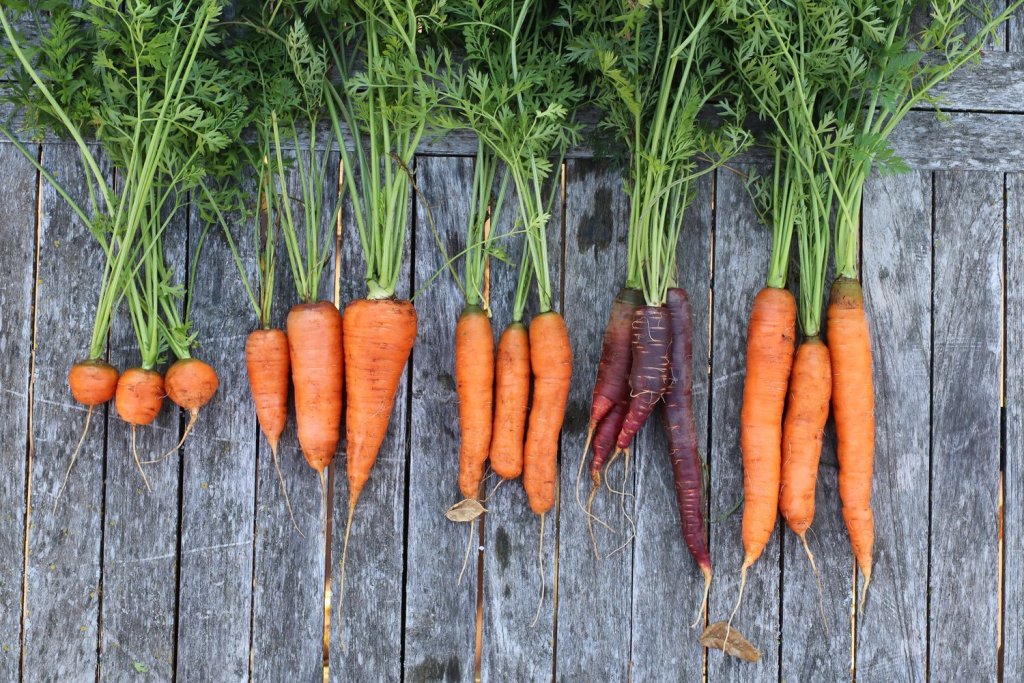
Atlas, Charentay, Nantes, Purple Haze and probably Bolero carrots (left to right).
We’ve tried pink carrots and other purple varieties, but we really love the extra sweetness orange carrots provide. Interestingly, orange carrots are highest in Vitamin A, more so than any other carrot color, making them the most nutrient dense carrot.
My favorite varieties are:
- Mokum F1 for early spring and summer harvests
- Purple Haze for fresh summer eating (short term storage is ok too)
- Bolero F1 for winter storage
- Danvers 126 for short term storage and potentially massive carrots!
- Chantenay a tapered shape that performs pretty well in heavy soils
- Atlas (Parisian) for clay soils or container gardening (round carrots, kinda novel but hard to peel)
Site Prep
Before planting, it’s important to be sure your soil is well amended and pitchforked. Carrot root tips are very fine and any obstacle will result in a hard right or left, that you will later unearth as a disappointing, albeit entertaining, forked or twisted root.
I use a pitchfork and sink it all the way in and pull back several inches, repeating every few inches around my planting area, hopefully, without puncturing our irrigation lines that are slightly buried. There’s no need to turn the soil over or dig it up, not even after you’ve just harvested something (unless there are large root balls from previous crop, then digging those out would be beneficial, such as large cabbage or broccoli roots from a spring planting, which is often where my fall carrots go.
If you have really heavy clay or rocky New England soil, I’d recommend starting with the Atlas carrot. All that carrot flavor packed into the top 2” of soil, your best shot at growing carrots in challenging conditions.
Sowing Tips
Probably the hardest part of growing carrots is getting the seeds to germinate. Even and constant moisture — not to be confused with super saturated soils — is paramount. Irrigation is also key for growing good carrots. Deep, consistent watering throughout the life cycle.
Seeds should be lightly covered with soil, too — aim for a planting depth of 1/4”. I sow seeds as thinly as possible so less thinning is needed later, but it still inevitably ends up being a densely planted area. If you have the patience to aim for a seed every 1/2” that would give you room to play as germination rates may vary.
Row spacing should be about 8-12” apart. Seed packets might say more, but I’ve been growing them more densely for many years now without any diminishing returns.
Soil temperatures should be at least 50F before sowing seeds, otherwise you can expect even slower germination rates.
Place a piece of burlap over the seeded area and water well, fully soaking the burlap. Repeat 1-2 times a day depending on cloud cover, temperatures, and season. This is a fair bit easier in the early season as the soil tends to retain moisture for longer in spring (when it rains, that is).
I’ve had carrot seeds germinate in 8 days in summer, which blew my mind last year. Normally, they will take closer to 14 days, even in summer. In the early season, they can take up to 3 weeks. Patience and moisture are keys to success.
Thinning/Plant Spacing
The second most important thing for carrot success is to thin the seedlings out. They are tiny, grass-like cotyledons, and it’s hard to tell the apart. I often wait a little while before thinning, but I always thin from the base of the plants. One stem = one carrot.
Stems that are too close together will be competing for nutrients and sunlight. Even as seedlings, they may grow a bit leggy on you.
By about 3 weeks after germination, you can start to thin. I thin over a few different times. The first time is to get to about 1/2” between plants.
The next thinning usually doesn’t happen until we have baby carrots ready to harvest, so another month to six weeks, depending on the varieties (Mokum works great for this strategy, by the way.)
My end goal is 1 plant every inch and rows, as mentioned, about 8-12” apart. This means 4-5 rows running parallel in the 4’ wide raised bed.
If weed pressure is high for you, beware that carrots are a low-growing crop and thus susceptible to weed pressure. I’d aim to weed every time you thin (at least 2 times in that first 6 weeks), and then again as needed as they reach their mature height of around 12” tall.
Fertilization
I amend the bed with slow release organic fertilizer at planting time and that’s it. No more fertilizing needed for carrots here. Our soil is rich with compost, too, and holds water well but not excessively so it’s a nearly-perfect growing medium for carrots. I’d say less is
Succession Planting
Carrots are one of our most important succession planting crops here. As mentioned, I start them in early April for summer eating. That’s about 4-6 weeks before our last spring frost.
But any time from about a month before your frost through to about 10 weeks before your first fall frost is fair game for sowing. You definitely don’t need to adhere to my spring and summer sowing, it’s just what seems to work well for me in that I remember to sow them (Fourth of July is when it starts to make its way toward the top of the mental sowing list).
Harvesting and Storage
Carrots store really well in the fridge, as long as you cut the green tops off (they make a pretty tasty pesto, if you’re into that … recipe will come out early this summer!). We tend to harvest about a week’s worth, cut the green tops and store in a gallon ziploc bag. If I’m not too frantic with life, I will lightly rinse them off before storing short term, but it’s also OK to just take a dirt-clinging carrot and plunk it right into your storage container and wait to wash until you’re ready to snack or cook with it.
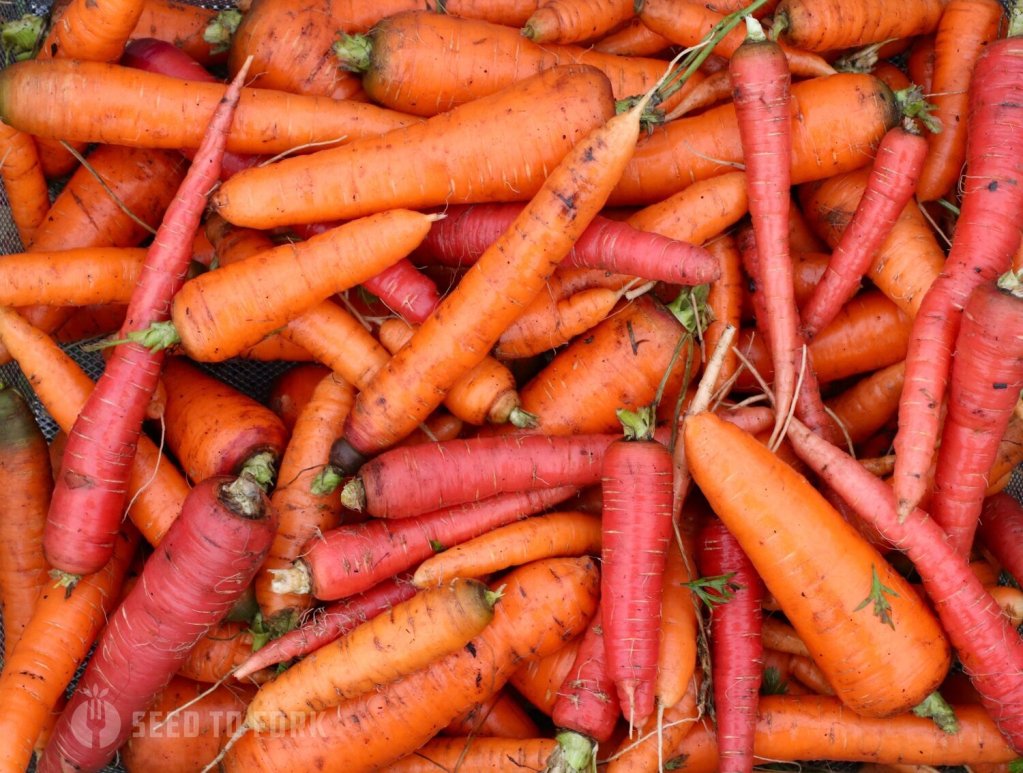
TIP: Limp carrots can be revived by plunging in water and putting in fridge for a little while (like how we similarly revive limp lettuce).
For super long storage, a high humidity situation is needed, like our root cellar. Or, alternatively, you can mulch and leave carrots in the ground for the winter. I did this with some that I cut the tops off of last fall. I haven’t dug them up yet, but I probably should to do a taste test between those and our root cellar ones to see if it’s worth leaving more in the ground in future years.
Here is a video I put together for one of my corporate clients two summers ago — the first 5 minutes demonstrate the prep, sowing, watering, and eventual thinning of carrots at both seedling and baby carrot stage. I think it’d be useful for the visual learners here.
You might also like:
Get updated by email whenever there’s a new post
Comments
3 responses to “Carrot Grow Guide”
If you’re a subscriber, you can discuss this post in the forums
-
Thanks, Meg! What is a good spacing for containers? Should I try to do rows or give each plant 1-2 inches around it? All my attempts to grow carrots in the garden failed. I have rocky dense soil and the carrots seem to pretty much stop at the compost layer. (I swear the rocks must multiply because I already removed so many and they just keep coming.)
-
Hi Joanna, I’d say space them 1-2" apart in rows about 6" apart. I bet you could space them even tighter, like 2" in every direction … I’d recommend trying the thinning method I mentioned in my video where you get baby carrots as you thin and they mature. Your rocky soil sounds very New England??? I hope containers make all the difference for you! Keep us posted.
-
Thanks.
Yes, we are in the upper Westchester in NY (which some already consider to be New England) and the soil has the same richness in rocks as a bit further north-east.
-
-


Leave a Reply