
Your cart is currently empty!
Welcome to Meg’s Blog
-
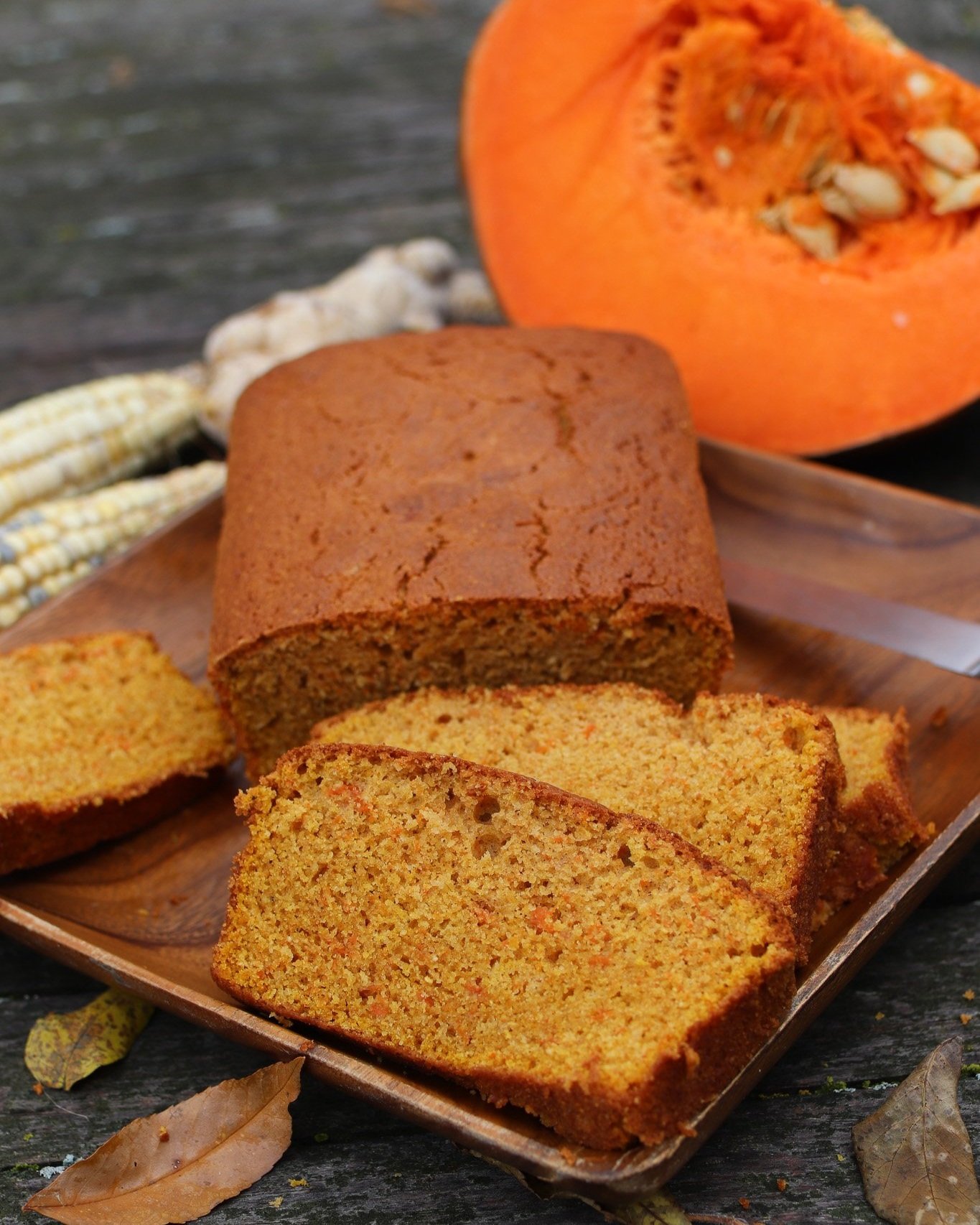
Autumn Loaf
This recipe is a riff off the Golden Pumpkin Loaf from Baking in America.
I’ve been making this bread for years, but like our pumpkin pie, I’ve transitioned from using canned or freshly baked pie pumpkins (which frankly don’t taste as good as winter squash) to any and every winter squash I happen to have around.
This loaf was made with some Musquee de Provence; however, pumpkin, butternut, delicata, or even kabocha would all work for this recipe. My motto is use what you have.
The cornmeal is transformative in my opinion. It’s just enough of a texture pop to make this bread one of my favorite things to bake in fall. I used our homegrown flour corn I grew last summer (2022), and the ginger I used was also dehydrated from a year or two ago that I finally ground down into a powder. It made this loaf that much more delicious knowing several of the key ingredients were homegrown.
Ingredients
1 1/4 cups all purpose flour
1/2 cup fine cornmeal
1 tsp baking powder
1/4 tsp baking soda
1/2 tsp salt
1 tsp ground ginger
1/4 tsp cardamom
1/4 tsp cinnamon
1/4 tsp mace (optional)
2 large eggs
3/4 cup firmly packed brown sugar
1/2 cup sugar
1 cup roasted winter squash, pureed
1 1/2 tsp vanilla extract
1/4 cup vegetable oil
-
Open roast your favorite winter squash or pumpkin at 350 for 30-60 minutes until soft. Let cool and scoop out. Mash and measure out one cup.
-
Preheat oven to 350. Grease a 9×5 bread pan and set aside.
-
Measure out the dry ingredients and mix to combine.
-
In a medium bowl with a hand mixer, whisk the eggs until frothy — about 1-2 minutes. Next, add the sugars and whisk again on high until frothy, a few more minutes.
-
Add the pumpkin, vanilla, and oil and mix again until well incorporated.
-
Finally, carefully mix the dry ingredients in using a wooden spoon or spatula. Don’t overmix — just mix until combined.
-
Gently pour into prepared pan and bake for 50-60 minutes.
-
Let cool for 15 minutes and then remove from pan.
Beware: it was a cat-approved baked good here, and the cats ate a bunch of it while I was out moving compost yesterday. So I took their spoils and placed it on the ground and let them continue their noshing.
-
-

It’s time for Another break
There’s no easy way to say this: I am shutting down my paid subscription in August. And here’s why. I have been letting myself down by not producing enough quality content this year, and the weight of underperforming, along with the exhaustion of saying much of the same things season after season has me trying to wring water out of a dry sponge.
In other words, I’ve reached the end of my own internet.
If I’m being honest, it’s been more like the last two seasons that I’ve fallen short of what I promised I’d deliver to subscribers. I invested big to rebuild the website this winter in a fit of excitement and vigor for a new way to convene and share information; I’d hoped to build community outside the realm of social media.
But what I’ve quickly learned since returning to Instagram this spring is that we are all lazy, and accustomed to being spoon fed entertainment and information that keeps our eyes glued to the glowing blue screen. Admittedly, I now get a lot of information –and surely misinformation– from that platform too. Ask me to head over to my website to check on a comment or reply to a question and it may take me days to do it because I don’t open my laptop up daily.
It’s been a really fun 3.5 years of building a very engaged gardening community, but I feel overdue in closing this chapter of my public life. I really hope you all understand that it’s run its course and that I’m ready to explore new ways of living creatively.
I will keep the seedtofork.com website active, and all content will be made public in the next few weeks. At that time, the Forums will be going away too. If all goes according to plan, these changes will go into effect a week from today (Thursday, August 7).
For annual subscribers, if you want a partial refund, I will gladly refund you for the months I owe you. No refunds for monthly subscriptions. Please just shoot me an email and we can work it out.
What’s Next?
I’ve been telling myself for almost two years now that I am going to write more. I have taken several amazing writing classes but haven’t been able to give them my full attention because of my other commitments. I’ve drafted some really great personal essays that I want to try to get published in journals. So, I am optimistic that not having the constant productivity tasks to create more content will provide the space and desire to explore what it means to be a writer for me in this decade.
Because I can’t just keep adding more. I have to decide what’s important to me. And now is the time to scale everything back and search inside my soul for what is next for me.
As I look back on my creative burst that became Plant Grow Harvest Repeat, it was not something I did in addition to other things. It was my sole purpose for a full year. Yes, I gardened. But I gardened to photograph the garden for the book. And yes, I kept up my social media posts, but that was the blissful era of single or carousel photos and short essay captions.
Those months and years made me a writer. And that muscle has weakened since then, and I miss the second nature of sitting down to pen daily thoughts. So I am giving up this wonderful community and the financial stipend you all generously give me monthly to try and find home within myself.
I will be writing more personal essays over on megcowden.com, but this garden website will remain a full and free website for gardening knowledge and recipes.
-
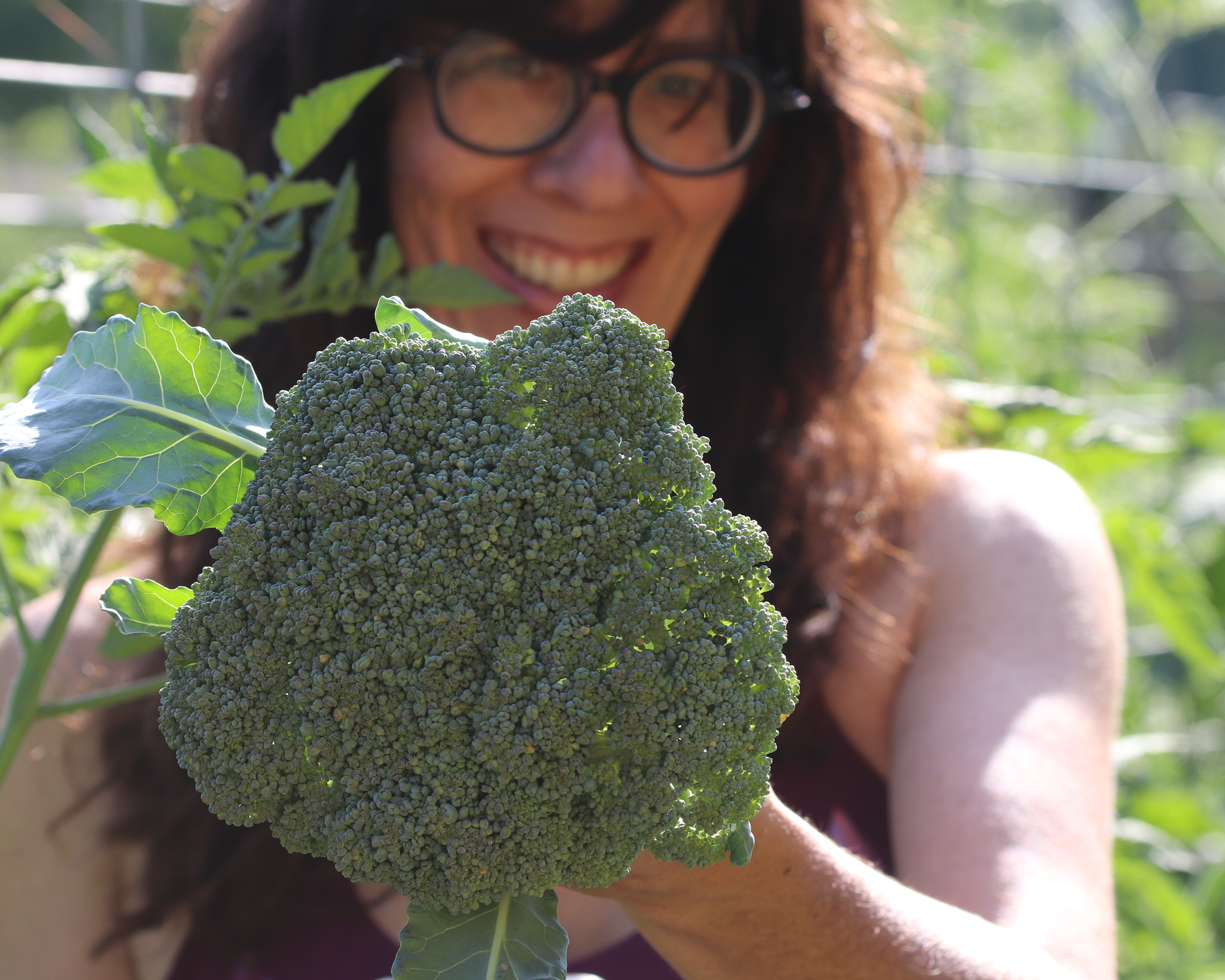
Managing Brassica Pest Pressure
There’s nothing better than a picture perfect cabbage patch, but it might seem an illusion if you’ve tried growing them only to notice small holes that quickly becoming massive munches and then, devastatingly, a stunted or frass-covered plant.

I’ve been there many times. Some years are harder than others with numerous pests challenging my sense of reality, draining my confidence that I know how to grow food.
This season has been particularly challenging for me. I’ve seen more pests feasting on our brassicas than I have in many seasons. And I’m finally feeling like I’ve gotten a handle on it and that my plan for combatting them is taking effect. So let’s dig in.
Identifying Pests
First off, you need to understand what kind of insect has been nibbling on your prized cabbage, broccoli, kale, collards, cauliflower, kohlrabi, or brussels sprouts. Because it’s not a one-size-fits-all approach to pest management. Different pests require different approaches. So pest identification is crucial here.
For the most part here in the north, the biggest thug that prevents cabbage patch bliss are Cabbage White butterflies. They overwinter as pupae and so once you see them, they will stay around for years to come. And they are prolific with 3-5 generations annually. I have seen cabbage whites emerge as early as late April here, so it’s a full 5 months of living alongside them.
Cabbage whites, also known as imported cabbageworms, are a round, smooth green caterpillar. Plump and not inchwormy (like cabbage loopers), they do a pretty good job of hiding in plain sight.
There are two other caterpillars (moth larvae) that have similar life cycles here: the cabbage looper and diamondback moth. Their larvae look slightly different: the looper has more prominent gait because they lack legs in their midsection, which is why I say they move like inchworms.

Cabbage loopers are more of a generalist. feeder and are easy to identify with their missing legs in their midsection, making them appear to be inchworms. 
The caterpillar munching on our brassicas this spring on the deck. I wonder if this was a diamondback moth? Diamondback moths remain smaller and have spots on their back. I am not 100% certain that’s what I found munching my fall seedlings on our deck in June, but it was certainly not the usual cabbage white larvae.

Diamondback moth photo courtesy of Bugwood.org. Beyond Foliar Damage
Other challenges can crop up with brassicas besides holes in the foliage. A tell tale sign of distress is wilting. And this is what kept cropping up for me this spring. Each week, another brassica looked wilty. After a windy day, it was game over as the plant simply snapped at the base. This frustrating pattern repeated itself several times over the course of four weeks before I correctly identified the culprit: cabbage fly root maggots.
Yes, there’s a fly that lays their eggs at the base of brassicas. The eggs – maggots, just like the gross squiggly things you might find in the abandoned compost heap – then start feasting on the roots. If you have a plant above ground that looks great, but then suddenly starts wilting? Be sure to dig around the base and see if the stem and roots are being chewed.
Lastly, though I don’t have this pest in my garden yet, there’s a pest that is making its way around the country called Swede Midge. This is a small, invasive fly whose larvae, like the root maggot, do the damage. This pest can prevent broccoli from heading and their larvae overwinter in the soil making it challenging to eradicate. Row cover at planting can exclude the fly from laying eggs, so long as it’s in a bed that doesn’t have overwintered larvae.
Timing Pest Management
The biggest and best strategy for pest management is to interrupt their life cycles. You do this a few ways.
First way, is always try to remove the adults. I am a big proponent of using a butterfly net to trap and kill cabbage whites. I don’t do this for night flying moths such as loopers though, because I am a sleep hygiene hawk.
Next, if your garden is small, locating the small white eggs on the top or underside of leaves is pretty easy. And quick to wipe off the eggs. If you see a cabbage white fluttering about and landing and pausing, you better believe they are laying eggs for the next generation.
After I kill as many butterflies as possible and squish the eggs, the next thing is to apply Bt. Bacillus thuringiensis (Bt) is a soil borne bacteria that targets lepidoptera (butterfly and moth) larvae. It is a “broad spectrum” in that regard: it will kill ANY butterfly or moth larvae. So you don’t just spray everything in the garden with this. You only spray your brassicas. Above and underside of leaves, I like to spray in the early evening.
Lastly, succession planting can help mitigate pest pressure a bit – especially if you plant under cover in early spring. I find that by the time the cabbage whites emerge, my first succession of brassicas are well past the tender phase and can withstand some pest pressure.
How to Choose the Best Strategy
The most effective pest management strategy is multi-pronged. Just killing butterflies means you will miss their eggs and larvae, who will become more butterflies in a few weeks. And along the way possibly destroy your prized crops. Only killing larvae means you’ll miss the eggs and adult, egg-laying pests which will enthusiastically be seeding the next generation. Only spraying for Bt means the butterflies and moths are still out there laying eggs. Just excluding the plants with row cover means you are betting on your soil being clean and your enclosure being insect proof.
I’ve not found this to be the case time and again. In 2018 when I attempted to use floating row cover to exclude cabbage whites from my plants because I was bananas for unblemished plants, I ended up having a terrible white fly or aphid problem on several brassicas under cover. The cover gave me a false sense of security and that singular event stung so much I have been very cautious with row cover. Younger Meg might have thought row cover would be enough, but now I know you have to still spray.
There’s not a quick fix for this problem. Maggots can be preyed on by beneficial nematodes. You can dig up the plant and soil and remove. But you have to be present and willing to put in the time and effort to find some kind of harmony (modest pest pressure without making yourself go totally bananas!). In the end, what we are aiming for is strong enough plants to withstand some pest pressure while still producing a head (of ______ insert favorite brassica to nosh).
-

Weekly Videos: Week of July 21, 2025
See what happened last week
This weekly video update is a part of your Seed to Fork subscription. You can always look back on previous weekly garden updates here. -
Weekly Videos: Week of July 7, 2025
See what happened last week
This weekly video update is a part of your Seed to Fork subscription. You can always look back on previous weekly garden updates here. -
July Monthly Task List
July is busy like May, though with distinctly different tasks. Swap out hardening off and transplanting for daily harvests, watering seeds and seedlings in the heat of the day, strategic succession planting of main season and fall crops, and the commencement of curing and canning season and your days are swamped, in the best way possible. I plan, anticipate, and love this time of year!
My garlic this year was a bust and I’m about to pull the planting; I’ll cook the green garlic and turn the space over. My onions are growing a bit slower this year, so I don’t anticipate them coming out of the garden until mid-August (some years it’s much earlier). Bush and pole beans are producing as of earlier this week, which is perfect timing since we are just finishing up last week’s final snow and snap pea harvest. My first few Goldy summer squash are swelling, and more cherry tomatoes are ripening every few days, and are being consumed immediately upon harvest.
Cucumbers are a ways out yet, but I’m seeing flowers on my picklers, which means in a few weeks canning season will return. Preserving food is both an offering to be present and a gift ourselves for many months to come.
July is also when the gaps must be replanted with quick succession, lest we lose these precious weeks of summer needed to ensure slow maturing fall crops size up fully before the sun dips into her Persephone period. Like my spring brassicas, my fall cabbages are lackluster, being plagued by cabbage whites and cabbage loopers, and I’ll be delighted to just get a few good cabbages to enjoy in late fall. Those transplants, along with my cauliflower, romanesco, and some battered broccoli, will be going into the garden by early this week. This has been the hardest part of the growing season for me, running into challenges with my previously most reliable staples. We can’t perfectly time all things every year, but with repeated plantings of things we love to eat, we will have a garden full of diversity for many months.

I intentionally delayed our summer squash season to coincide with after our vacation by keeping them covered with insect netting until July 9. This was two-fold: It prevented any squash vine borers from laying eggs and eliminated the need for neighbors to have to harvest and cook with them in our absence. Just a few days later, and we have squash ready to harvest for dinner! Garden Tasks
Since I’ve already direct seeded some fennel, head lettuce, and late cabbage, I think I’ll just direct seed the remaining seeds into the garden this month. It will include kohlrabi, beets, bok choy, and more head lettuce, things I know for a fact all grow well direct seeded, in an ideal, pest-free landscape. I’ll highlight what to sow this month below, as there’s still lots of hot season crops to sow in addition to fall vegetables and quick herbs. But let’s start with the day to day tasks that require time and attention:
The weeds are growing! We are trying to stay on top of fast growing weeds in our perennial beds. I still need to dig out a lot of quack grass thriving in some of the beds, but otherwise the annual veggie and flower beds are in pretty good shape.
Mowing the paths continues to be a central theme due to our plentiful rainfall. I am mowing them every 1-2 weeks still. Usually in July I can reduce my frequency, but not this year.
Managing for pests is another big, ongoing task — especially on the brassicas. I am chasing cabbage white butterflies everyday, and my killing streak is strong. I probably murdered 20 of them last week alone. That combined with spraying Bt to target their young larval stages and I feel optimistic I am doing ok. Maybe I’ll try the fine nylon netting again for some of the fall transplants because those pests really derail my garden enjoyment. I just can’t sit still while they sip nectar and lay eggs on my veggies.
Pruning cucurbits is something I will start doing soon. Like tomatoes, they send out new leaders (suckers) at every leaf node and it quickly becomes a veritable jungle, even when I train them vertically. I prune for air flow and for ease of harvesting. Don’t be afraid to apply this to your summer squash, melons, and winter squash in addition to cucumbers.
I am also regularly coercing cucurbit leaders up their vertical cattle panel trellises so they fill them out. They would happily creep horizontally out into our paths or crawl over nearby flowers but I do take time daily to “thread” them through the cattle panels.
Pruning the tomatoes is ideally a weekly task, assuming it’s dry enough to get it done. Ideal meteorological gardening conditions for opening a wound on a plant are sunshine, breezy, and low humidity. I am still implementing my 3-leader trellising approach to tomatoes. This summer has proven tricky for timing pruning, and fungal foliar diseases have set in quickly on my Sun Gold and Paul Robeson, of course my two ride or die tomatoes. We can’t have it all; perfect tomato plants and plentiful rain leads to increased fungal disease.
My very late determinate tomato plants that I ended up indoor sowing in a 4″ pot on June 1 still need to be horizontally trellised. I spaced them 36” apart; it’s possibly more than enough room. It feels like farmer spacing, that is, a lot of open ground between the plants. I feel like we’re under-utilizing the space, but I know that disease pressure circulates rapidly in these plants and this spacing makes for easier harvests. I’ve interplanted them with gem marigolds and lots of genovese basil.
Soon I’ll be cutting down the flowering buckwheat cover crop to make way for those fall cabbages and cauliflower. I plan to get them transplanted this coming week, which is on schedule relative to a typical year.
Because our strawberries didn’t put out runners last year, we didn’t need to renovate the strawberries this summer. He’s still applying Surround (kaolin clay), potassium bicarbonate (an organic fungicide), and neem oil to the trees. He did a heavy summer pruning this week, too, so the orchard is looking amazing. We just need to hope the squirrels don’t steal our apples this year!
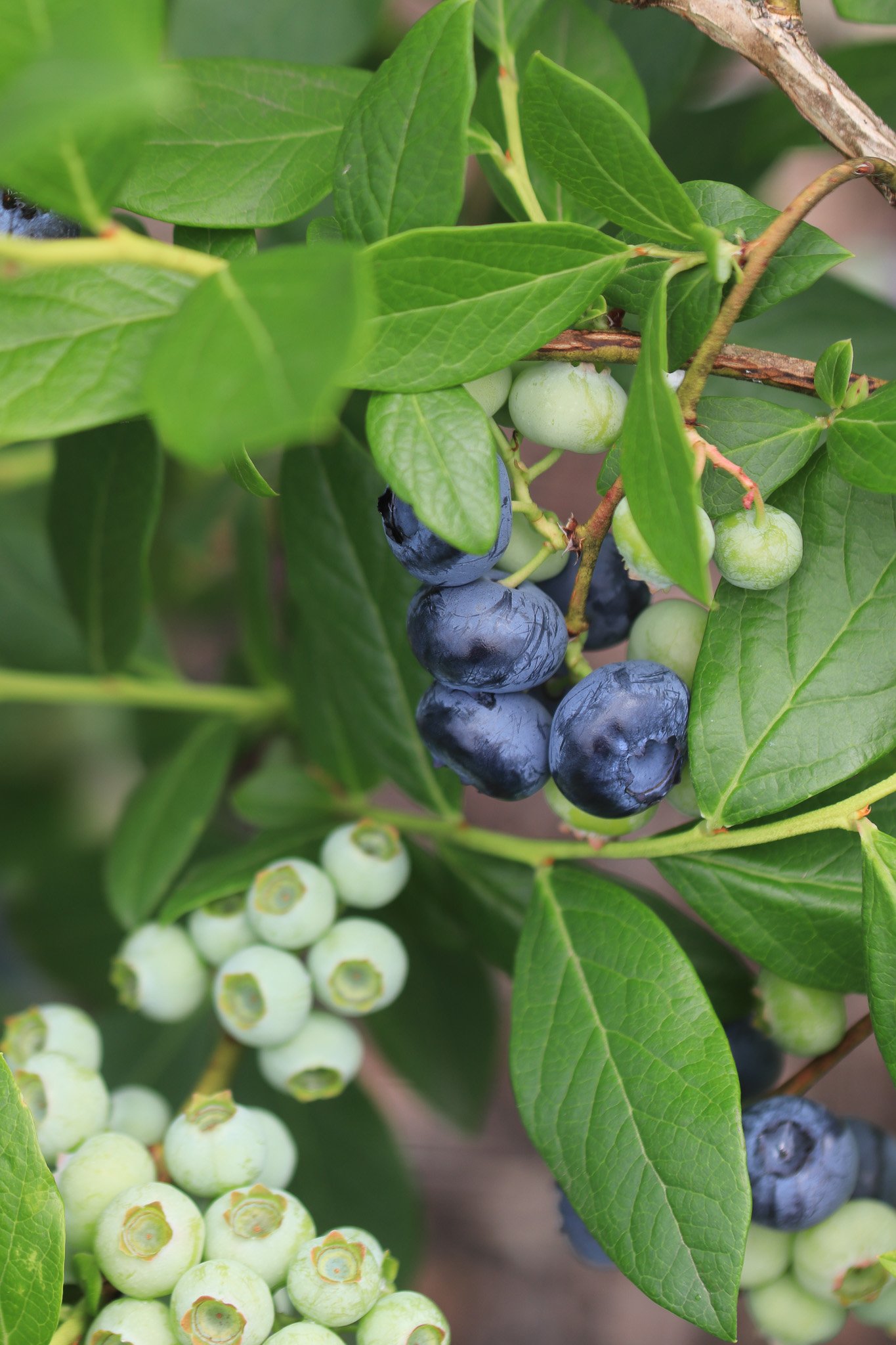
Honeyberry season has concluded and we are just starting blueberry season this week. Because of John’s heavy pruning this winter, we don’t have as large of a harvest as last year but the plants are generally putting out vigorous new growth which means next year should be an incredible harvest! What’s In Season
- Green beans (snap, still waiting on pole beans)
- Fennel
- Celery
- Tomatoes
- Summer squash (will be ready this week)
- Lettuce (heat tolerant, second succession of lettuce)
- Carrots
- Onions (harvest fresh as needed)
- Basil, Dill, Cilantro, Parsley, Oregano, Rosemary, Thyme, etc
- Arugula (onto our 3rd planting, with the 4th just germinated this week)
- Green cabbage
- Spigariello
- Blueberries
What to Sow Now
Here in the North, I’m looking at the final sowings of summer squash and snap beans in the next few weeks. If you’re south of me, count back 8-10 weeks before your first frost to calculate for your possible change to sow these as a late summer succession. This usually coincides with decreased daylight and cooler temperatures, all factors that determine if hot season crops will thrive.
My sowing focus has shifted for the season. I’ve got my third second succession of corn in and I’m done planting corn for the year. I sowed my fall carrots (last week) and now am done with carrots for the year too.
If I want fall peas, I will sow them by the third week of July. Again, like with transplanting cabbages in heat, it is a bit perplexing to sow peas during a heat wave, but the timing works out — a similar 8-10 weeks before frost (they need 60 days to mature, so that’s 8 weeks).
Direct Seed
- Snap beans (now until end of July, which is pushing the season for a late harvest but I know it works!)
- Cucumber and summer squash (for September harvests)
- Carrots (sow before last week of July in the North)
- Fennel (I’m direct seeding it this year … wish me luck)
- Green onions (every few weeks for a steady stream of bunching onions)
- Arugula (every other week for steady supply)
- Basil
- Cilantro (every other week for a steady supply)
- Dill
- Bok Choy (I prefer hybrids like Joi Choi for their heat tolerance)
- Kale
- Head lettuce
- Beets
Wait to Sow
Don’t sow any spinach or leaf lettuce yet, nor faster globe radishes, kohlrabi, or salad turnips. Late July into early August is my final big sowing window, which includes storage radishes and turnips (50-day varieties), and they will get seeded once I pull out the onions.
As we near August, my seeds will reflect the shortening weeks to first frost, and my seed list will be solely focused on crops around and under 50 days to harvest, and largely smaller crops and leafy greens.
I hope you find a pace at which your garden will delight and encourage you to succession plant your favorite things all summer long. Our presence is the most important part about our gardening journey. Pay attention every single day.
-
Weekly Videos: Week of June 30, 2025
See what happened last week
This weekly video update is a part of your Seed to Fork subscription. You can always look back on previous weekly garden updates here. -

What I’m Sowing Now
We’re nearly at the end of June already and I’m still waiting for consistently warm weather to arrive. Despite this, my melons and pickling cucumbers are climbing, albeit slowly. My earliest tomatoes, Sun Golds of course, have ripened, the bush beans are flowering and setting fruit, and my corn is way past knee high. The earliest cilantro and arugula have bolted as the second succession is just ready to harvest: this is the reminder to sow another row of each for next month. Like today. Make haste!
The strawberries are slowly coming in, at a much more meager pace than years past. Honeyberries are mostly going straight into the freezer for smoothies, and we are eating our fill of snap peas and now snow peas, sharing them by the pound-full with friends and neighbors.
But this week is a key week for replanting the garden, for preparing for second and third successions of main season crops, and for starting more fall crops so we will have a robust garden in October and beyond.
Direct Seeding Vegetables
My focus for direct seeding is largely on main season crops: beans, corn, arugula, cilantro, beets, carrots, green onions, and more summer squash (that will hopefully escape the squash vine borer).
I may also direct seed some broccoli and cabbages in our cold frame after I — ahem — clean it out. It’s sort of a mess from everything that flowered from my winter sowings.
Quick maturing culinary staples that can continue to be direct seeded:
- Arugula
- Cilantro
- Scallions/green onions
- Bok choy (yes, you can sow this all summer!)
Main season vegetables and herbs to direct seed now include:
- Carrots
- Beets
- Dill
- Corn
- Snap beans (pole or bush)
- Dry beans (I’m sowing bush dry beans in a very loose 3 sisters planting, but for sure last call!)
- Winter squash (I let my seedlings perish so I’m direct seeding some … never tried them this late)
Sowing Indoors
As we rapidly approach the end of June, my indoor seed starting begins its final season. And I am already breathing a sigh of relief. I love reaching this point in the growing season, it’s one of many mental finish lines I cross in summer.
I’ll sow a tray this week, and then one or two more trays in July, mostly focused on lettuce and beets for transplanting in early August.
Right now, I am focused on my main season brassica varieties, not storage cabbage (too late to grow those):
- Broccoli
- Cabbage (red and green)
- Kale (dwarf blue and scarlet)
- Beets
- Fennel
- Heat tolerant lettuces:
- Coastal Star
- Concept
- Jericho
And yes, you could probably direct seed ALL of this, but as you intimately know, I have an entrenched relationship with indoor seed starting.
What I’m Transplanting
This week, I’m transplanting my most recent 2 trays:
- Basil (2nd succession)
- Zinnia (more zinnia!)
- Cosmos (more of those too!)
- Watermelon
- Celery (for fall)
Transplanting late next week:
- Cauliflower
- Storage Cabbage
- Romanesco broccoli
- Belstar broccoli
Keep sowing with curiosity and reverence for the seasons that lie ahead.
-
Weekly Videos: Week of June 16, 2025
See what happened last week
This weekly video update is a part of your Seed to Fork subscription. You can always look back on previous weekly garden updates here. -
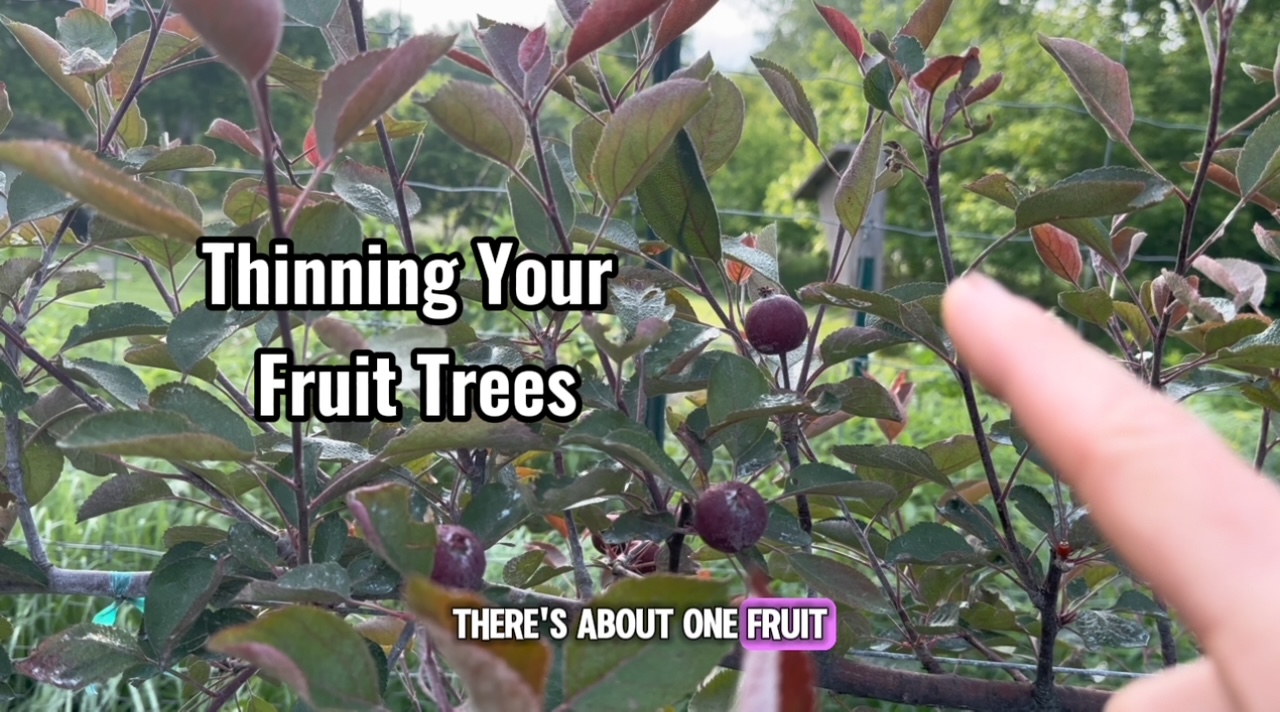
Thinning Fruit Trees
Like pruning, thinning is another important aspect to the art form that is orcharding. How and when you choose to remove fruit in late spring will determine how well the harvest will be and also next year’s fruiting potential.
There are recommended ways to care for your fruit trees. But in the end, growing fruit trees is a long term commitment, one forged through seasons of trial and error.
The biggest reasons you want to thin your fruit trees are:
- To ensure the best quality fruit
- To ensure the tree has energy left to produce fruit buds for next year
- To minimize the weight of the fruit on branches to prevent branches from breaking
It’s especially important for open grown dwarf trees to thin your fruit every year.
June Drop
Apples will drop some fruit naturally, but you’ll need to take an active hand in removing more than what they will drop on their own.
Plums, peaches, and apricots will drop fruit on their own. This is known as June drop.
Practice not Perfection
Learning how to care for your fruit trees is a years-long endeavor. You’ll see in this video John continues to “break the rules” when it comes to how far apart to space your thinned fruit.
Many university extension resources say to thin to 6″ between fruit, or one fruit per fruiting spur. For our haralson this year, there were SO many blossoms and fruit that we ended up with more like 1 fruit for every 4″ or so.
And on other trees that had little fruit, John didn’t even knock any fruit off, confident that the fruit load wasn’t too heavy for the plant to carry or for it to have enough resources to develop fruiting buds for 2026.
But of course, time will tell!
-
Weekly Videos: Week of June 9, 2025
See what happened last week
This weekly video update is a part of your Seed to Fork subscription. You can always look back on previous weekly garden updates here. -
June Monthly Task List
June is when the growing season and garden makes a giant leap from plants to planted. From wispy to lush. From flowering to harvested. I’ll even transition some beds this month from spring to summer crops. It’s the month we finally taper off grocery shopping for vegetables for the season, save a few odds and ends here and there. We’re currently still buying fruit, carrots, mushrooms, onions, and — gasp! — cabbage, but that’s about it. It’s nothing short of awesome.
June’s also when I transplant out all my indoor started hot season cucurbits — cucumbers, summer and winter squash, and melons. They are true heat lovers, and this belabored spring weather is not a friend to them. I did transplant them out over the weekend (June 8), and I may have mild regrets about it. I’ve watched cucurbits struggle during a cold, wet spring/early summer, and that’s exactly the kind of season we’re having. If I have to replant, I’ll direct seed later this month.
What’s In Season
We’re finally in harvest season. The spring garden has been slow to kick in, largely because I lost my first trays of early brassicas and had to start over in mid-March. Then the pests in the raised bed soil further dampened my spring garden. But, we’re finally harvesting food and centering our meals around our seasonal produce.

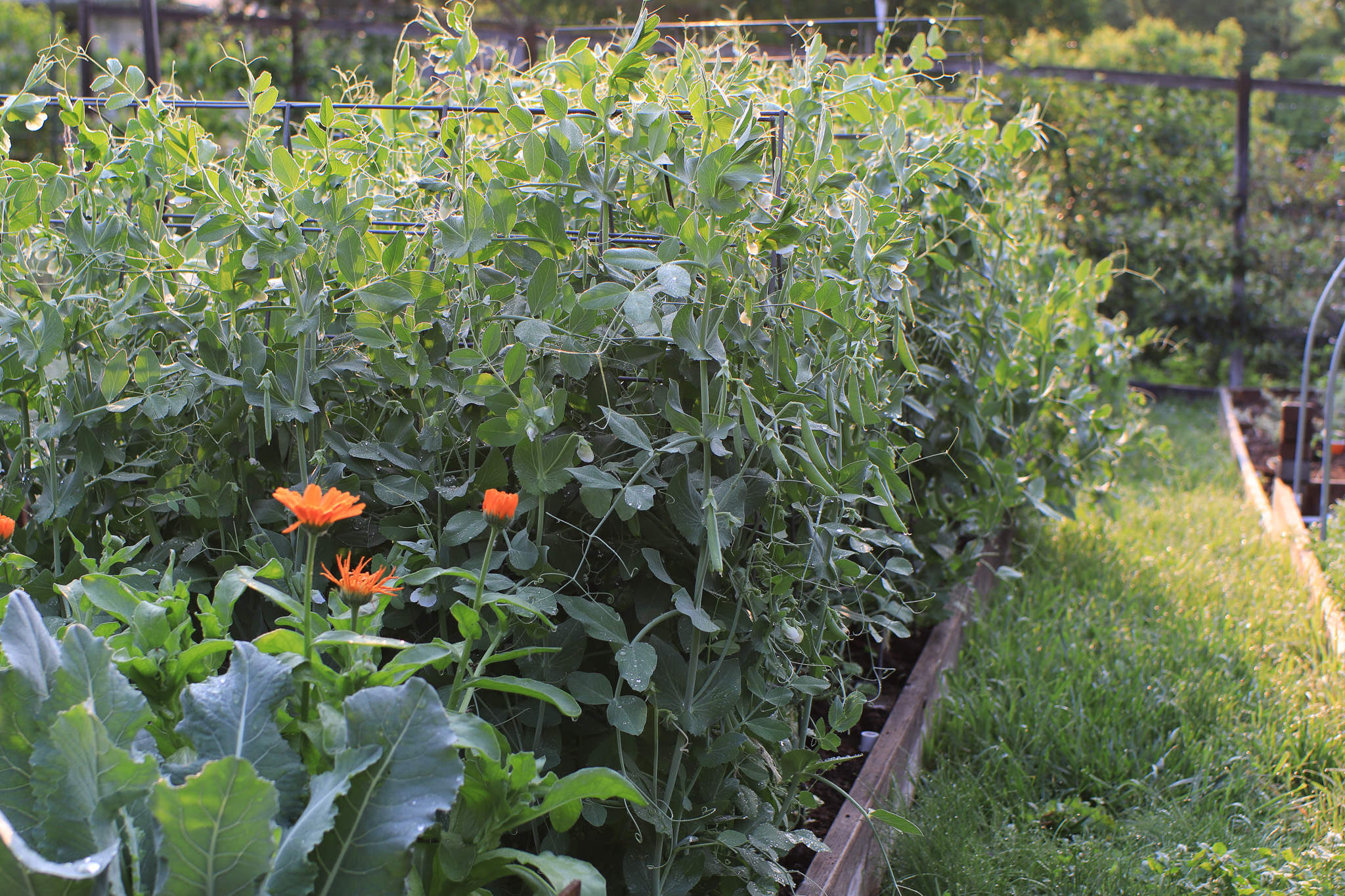
Our spring snap pea bed is a clear winner! Peas are very disease resistant to me, which nearly brings me to tears this year. it’s a breath of fresh air to know they will produce, abundantly, for 3 weeks in June. We continue to harvest and share lots of asparagus, cilantro, arugula, and radishes. A few select neighbors have received a head of iceberg lettuce. We’re enjoying the most meager broccoli from the variety, Piracicaba; it produces smaller heads, but loads of side shoots. It’s going on sourdough pizza tonight.
We’ve got a second cauliflower nearly ready for harvest, along with one of our napa cabbages (which are not doing well … I’ll go back to hybrid varieties next year).
The strawberries are just rolling in and we enjoyed them fresh with whipped cream for dessert last night, possibly the simplest and most divine dessert in the world.
It won’t be long before we have string beans — I see flower buds on both our bush and pole beans! Fennel is sizing up, as are the beets.

Honeyberries continue to ripen, though not as early as our June-bearing strawberries. They need more time, as the more they flatten and shrivel up, the sweeter they become. Ripening tip: they shouldn’t be white inside (at all), even though they are somewhat ripe at this stage. The longer you wait, the sweeter they get. Garden Tasks
I have taken up a lover. Their name is weeding. I feel lost without some time kneeling beside a bed, carefully digging deeply and pulling up the rhizomes of the quack grass or lifting errand milkweed plants (after checking for eggs) out of beds. It’s a way to keep me outdoors, in the space I carefully cultivate, and also keeps me off my devices which is a blessing too.
I’m trying to dedicate up to 5 hours a week for weeding and mowing this spring. Speaking of which, it’s been almost 10 days so it is time to edge all the beds and mow. I’m adding that to my list this week. Once it warms up more, the cool season grasses will slow their growth. I’m looking forward to (that) summertime when it arrives.
Setting Up Trellises
I haven’t set up our tomato trellises yet, but that is at the top of my list once I complete all my computer work!
Supporting the peppers and determinate tomatoes is also high on my list. I am going to use the horizontal panel approach for peppers this year, which is the same method we’ve been using on our tomatoes for the last 2 years.
Tying up the peas and beans is a weekly task too. I basically use the same method for both, just the peas need taller stakes.
Pruning the tomatoes will soon be a weekly task, once I get them trellised! We are in a rainy period so it’s going to be tricky to find a good, breezy and dry day to get it done. This is essential to minimize fungal spores entering through the wounds caused by pruning. Low dew points and breezy are the best days to prune tomatoes.
Keep an Eye out for pests
I’m on the lookout for cabbage loopers and cabbage whites, Colorado potato beetles, three lined potato beetles, asparagus beetles, and keeping a close eye on the ants and cutworms that are currently plaguing me.
If you watched this past week’s video, you know that I applied beneficial nematodes to most of the garden last week.
Thinning the Fruit Trees
We just did a difficult task over the weekend: removed 2/3 of the fruit on the haralson apple tree. Every single bud flowered this spring. It was epic! But trees cannot sustain that many fruits, so one must remove most of the fruit in order to yield lots of healthy fruit.
If you have a tree that has lots of clusters of fruit, carefully trim off the smaller fruits of the cluster and leave the largest, healthiest looking one. I’ll be sharing more specifics on this in this week’s videos coming out Saturday, June 14.
Hilling Potatoes
Potato hilling helps ensure the plants have maximum opportunities to form tubers underground. This is why I dig a trench and plant my potatoes deep and then hill them up. You can also plant them at ground level and hill them up with mulch or soil too. This task is always a June task, and I let the potatoes tell me when it’s time. It’s time when the plants are 6″ or more above the height of the raised bed. It came up a few times in this week’s videos, and I showed completed hilling toward the end of this video.
What to Sow Now
As mentioned, indoor sowing my fall transplants is high priority.
Lots of direct seeding from here on out though, which requires diligent watering for germination. Just a note: your in line irrigation system is not sufficient to aid germination, especially in things like carrots. I always hand water direct seeded crops until I see germination, sometimes twice a day in a heat wave. Once I see germination, I can back off a bit — down to once a day — until I am satisfied with complete germination.
Keep sowing those herbs, cilantro especially, every few weeks for a steady supply. Just 12” of densely planted seeds is all one needs for a few weeks of good harvests before it bolts.
Some longer season crops can still be sowed, even direct seeded this month, but make haste. This includes potatoes, melons, and things like popcorn or pole beans. Think crops that take a full 3 months from seed to harvest (that 3 months puts my calculations into mid-September! Eeek, please not yet.)
Indoor Sowing
- Cabbages
- Cauliflower
- Celery (last call for fall garden)
Herbs
- Basil, all types
Direct Seed — cool and warm-season crops
These veggies can be sowed any week this month:
- Green onions
- Arugula
- Cilantro
- Bok Choy
- Kale
- Head lettuce (heat tolerant)
- Beets
- Carrots
- Fennel
Herbs
- Dill
- Cumin
- Fenugreek
- Mustard
- Nigella
Direct Seed — warm season
- Beans — dry, snap (last call for pole this month)
- Corn — sweet, popping, or flour (last call for popcorn or dry corn is mid-June)
- Potatoes — final call for planting potatoes this far north is June
- Cucumbers, squash — can plant these anytime in June
- Melons — watermelon and muskmelon — last call for planting these is mid-June
Flowers
- Zinnia
- Cosmos
- Alyssum
- Nasturtium
- Sunflower
These flowers I’d direct seed in June if you haven’t started any and want a pop of color in August and September. There’s plenty of time for them to flourish. I omitted snapdragons and calendula, both cooler season flowers, though they would make a great comeback/garden refresher as a September/October flower as they are both tolerant of light frosts.
What to sow later in June
My final indoor-sowed brassica succession will get sowed in late June, including broccoli, main season cabbages, and more beets.
I hope you find a pace at which your garden will delight and encourage you to succession plant your favorite things all summer long.
-
Weekly Videos: Week of June 2, 2025
See what happened last week
This weekly video update is a part of your Seed to Fork subscription. You can always look back on previous weekly garden updates here. -

Growing A Resilient Garden
The climate is changing, and our gardens are some of the first responders. Insect populations are doing crazy things already this growing season, and it reminded me that sharing how I approach building our garden to be climate resilient is a topic deserving of some attention here. So this month’s guide is a brain dump of all the ways I approaching gardening from planting, replanting, unplanting, and playing in the garden to help build a garden that is robust and resilient to the changing climate.
How the Climate is Changing
Here in Minnesota, we are seeing many more high wind days. This uptick in wind events became noticeable about four years ago and hasn’t let up. Even as I write this because of winds and dry conditions we have fire alerts in our area (no burn advisories, etc) which was not normal even 5 years ago.
As if wind wasn’t hard enough, toppling plants and sometimes even killing them — I lost a few, full grown nasturtiums last summer due to high winds — we also seem to be in a feast or famine pattern with rain, and have been since about 2019. First it was soaking rains, unrelenting rains, rains that flooded our front yard. Then the drought arrived during covid in 2020, and we’ve not had a great, reliable summer of consistent rains since then.
The other thing that we all experienced in the US was a “redistricting” of our plant zones a few years ago. This was a big deal for some – many, I presume – and at first glance a warmer plant zone might mean a peach tree is now within reach. But how we approach it is still plant on the side of the polar vortex, the colder zone, because it does seem that with the wind and drought and occasional flash flood, extreme cold snaps will continue to dip further south than historically.
So on paper, I think we are now a zone 4b, but I still think of us as a zone 4a. And honestly, when we plant perennials, we like them to be zone 3 hardy, especially our fruit trees.
It sounds onerous, overwhelming, and out of our control. Because it is. But what is in our control is how, when and what we plant. And also how we make changes to things that are challenging now, or challenges to come. And that’s what I want to focus on.
What we can do about it
It’s a hard topic to delve into because the climate crisis is daunting, and honestly I’m feeling as battered as my bok choy looks right now, but we have control over our landscapes and have the power to shift focus and find opportunities in numerous ways.
Rethink perennial Edibles
I mentioned this above, and it’s worth diving into further. Perennial fruits are a bigger investment in money, time and space than your tomatoes or beans. They require extra tending and fretting (hello, blueberries!) and more inputs to produce food. But, when they do start producing, boy do you feel like a rock star!
I’m a firm believer the most climate resilient garden prepares for the coldest weather. Because cold weather is what determines whether a perennial can survive your winter. And a cold snap with snow is not as cold underground as a cold snap without snow (hello, droughts, which also happen in winter here now … cue depressing music).
So when we plan new edible perennials, we choose at least half a zone colder than we are. That is to say, we buy things that are hardy to at least zone 4a (we might now be zone 4b). Better yet, when we selected our pear trees a few years ago, after having lost one to a cold winter, we bought zone 3 hardy pears. This way, our plants won’t succumb to the wobbly polar vortex of future winters, an inevitability we won’t avoid.

Embracing native edible shrubs is another fantastic way to thwart the changing climate and bring resilence to your garden. Elderberries, chokecherries, serviceberries, and more are all adapted to our northern climate. They can be added as more formal plantings. Common elderberry is a fast-growing, bird-loving, tall shrub that will provide a privacy hedge upwards of 10′ in a few years. It’s also medicinal and the flowers can be used too. I love that it brought a flock of cedar waxwings to our property.
Plant Native Flowers
This is a topic in my book as well as something we deeply believe in: rely on your historically endemic plant species when you consider new plantings/gardens on your property.
For us, this is a slow but steady move to reintroduce native seeds — flowers, sedges, grasses, shrubs — to as many areas of our property as we can. We aren’t completely ditching our lawn but have reduced it dramatically, converting over half an acre to native prairies instead.
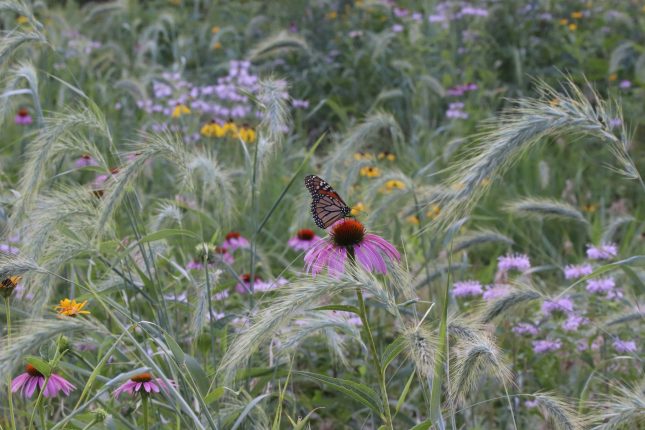
The benefits of planting these species are many: they sequester carbon, are drought tolerant, build soil, attract and provide habitat for native insects whose precipitous decline is alarming, and makes a really beautiful, vibrant, low maintenance garden. This will naturally attract predatory insects to your property, which will feed on various pests. For example, the familiar bluet who I see every summer hunting and consuming asparagus beetle larvae. Or the goldenrod soldier beetles whose grubs hunt other grubs, such as the Japanese beetle. More insects usually means more resilience, and a prairie or other native garden is a great way to enrich your local environment and your life.
Choose pest resistant crops
This is a main focus of my food garden lately: choosing crops that are pest resistant. Now I also grow a LOT of food that is pest susceptible like all my cabbages, broccoli, brussels sprouts, etc. But by and large, I lean on pest resistant foods, foods that for me have low pest and disease pressure. This buffers my harvests with some easy to grow plants that are very low mainentance, including:
- onion
- potato
- corn
- beans, dry and snap
- lettuce
- carrots
- beets
- peanuts
- sweet potato
- sesame
- herbs, especially dill and basil
Plant Diversely
Planting less of something reduces our risk. Think about how devastating it would be if all I grew was tomatoes and my soil was full of spores from septoria leaf spot, which, by the way, I’m convinced it is. Every year I would simply be exacerbating the problem, providing habitat for the spores to proliferate.

By planting my garden in smaller blocks, my risk is greatly minimized. Think about my spring beds this year: I have had a terrible time with my brassicas but my peas, which as noted above are disease resistant, have thrived. My broccoli is a bust but my interplanted iceberg is thriving. My beets are doing well but I have NOT a single kohlrabi, as the few seedlings I planted all shriveled up.
The more diversely we plant — and this includes spreading the plantings out through succession planting — the more chances we give our garden to outwit the weather and pests.
So I guess, slowing down our planting and spacing things out is a great way to garden for this new climate too, something I’m embracing more this year too.
Trial New Varieties
I am a huge proponent of this. Always try a different seed type/variety if you’re unsuccessful at a crop. Don’t give up or think you can’t grow it. Different varieties can make a huge difference in how they grow in your garden.
One of our biggest changes in regard to this was moving away from pole beans to bush beans due to excessive Japanese beetle damage. We left our beloved Fortex pole bean behind after 15 years of reliable bean harvests. It was just a magnet for the beetles and we were tired of all the soap pails of water.
Bush beans were much more reslient to the beetles. My theory is they are lazy in flight and land on the taller things first. They often cling to our dainty asparagus foliage too, which tops out around 6′ tall.
Play with your Seasons
Succession planting is a big part of how I grow a resilient food garden. Especially staggering successions, planting a crop at different times. We currently have 2 sweet corn plantings growing and before too long I’ll plant our third and final sweet corn planting. This gives us corn for longer and also keeps opening up space in the garden to replant all summer long.
Staggering successions can also thwart pest pressure. Take edamame, which is a fun crop to grow and used to be pest free. That is, until the Japanese beetles started to show up.

Japanese beetles also really love soybeans (edamame). After intense pest pressure I tried the easiest change: timing. I changed the sowing to later in the growing season, which greatly reduced pest pressure. Now, instead of planting in late May, I delay planting until late June. The edamame are ripe later in the season, after the height of Japanese beetle foraging. The plants are more productive and less defoliated. It’s an easy change that made a big difference. Less food I attract the beetles with, the fewer grubs will overwinter in our soil.
The Summer pivot
Hopefully you know this is a big part of my gardening mantra: be ruthless and pull out plants that are either not working for you or are done producing or that you’ve satiated yourself with and are needing space for a different crop.
This is especially important during the middle of summer (late July to mid August) here. It’s when I try to complete my canning of pickles to free that space up for fall root crops and quick growing leafy greens. It’s also when I might reset a summer squash planting to curtail the squash vine borers.

Pickling cucumbers no longer have a full summer home in my garden. I grow more, so I can complete canning by mid-August, which is when I direct seed my daikon and watermelon radish for our root cellar. Just because you planted something doesn’t mean you have to keep it in your garden until frost. You can reset a bed any day of the growing season. This is a big part of my succession planting strategy, and if you haven’t tried it yet, I encourage you to give it a go this summer!
Pay Attention
At the end of the day, all of this advice can boil down to one key tenet: paying attention. Observe. Spend time in your garden. Know your varieties and think about how you timed them. Play with your sowing schedule and succession planting to try and outwit the timing of pests. Our attention is what we can offer the garden. It’s how we can adapt to the changing climate.

I paid attention one summer and started noticing monarch caterpillars not just on the leaves, but also on the flower buds of milkweed. These are the kinds of lessons waiting for us when we turn our attention to our landcapes, learning things by giving our time and full self to our gardens.
-
Weekly Videos: Week of May 26, 2025
See what happened last week
This weekly video update is a part of your Seed to Fork subscription. You can always look back on previous weekly garden updates here. -
Weekly Videos: Week of May 19, 2025
This week’s video is a full week — from Tuesday, May 20 to Tuesday May 27, about 20 minutes long. It covers more hemming and hawing over when to plant my flowers due to high winds and rain and cold, plus updates on direct seeded crops and my rundown of what I seeded for hot season cucurbits.
See what happened last week
This weekly video update is a part of your Seed to Fork subscription. You can always look back on previous weekly garden updates here. -

What I’m Sowing Now
The weather feels like a mirror to my interiority: stress, unease, and worry dominate my mental background noise as I work to find the rhythm of the season, seek out sunshine, praise the rain, and believe in the fundamental good of humankind. In doing so, I care for our little planet and hope for peace and equality for everyone as I go about my gardening every single day.
And yet, here I am, behind with transplanting. I use that word not to be dramatic. To have such large zinnias in such tiny 1 1/2″ soil blocks after May 15 is downright unusual for me. But here comes another round of wind. I really need to heed the lessons of the wind, those that I have not yet reaped because I’m still listening to what it is teaching me about how to garden differently. I keep losing plants to its ferocity, either by sheer desiccation or by severing plants at the base. And with the wind comes cooler temperatures and much needed rainfall starting tonight and lasting for a few days.
Weather determines our garden plans this time of year, so I am holding off planting my zinnia, cosmos, marigolds, dahlias, and gomphrena for a few more days. We have a low of 39 predicted for Wednesday night and so I am waiting to plant them until Thursday. I might tuck a few in and just see how they do, but won’t risk them all.
I’ve got a few trays to start indoors this week, and then again next week I’ll sow some brassicas for the fall garden beds.
Direct Seeding Vegetables
It’s time to shift from cool season direct seeding to main season/heat tolerant crops. These are all mostly 2 month crops, give or take, so we are moving away from little strips of radishes and arugula going in between where we will plant our tomatoes to a larger chunk of space that will be fully occupied until probably August.
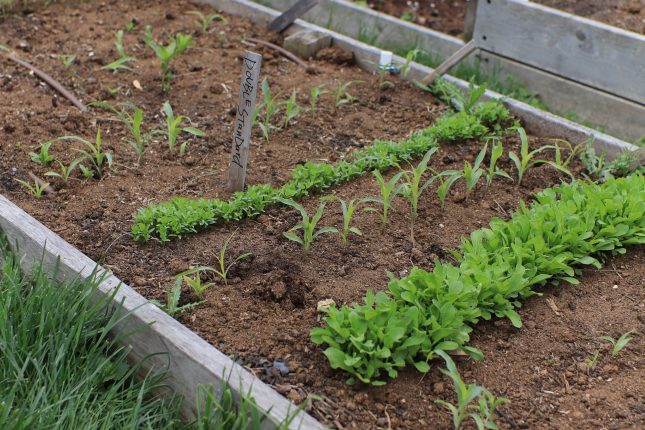
Make use of your main season plantings by interplanting with quick successions. Here I have arugula and cilantro planted in dense rows between our earliest sweet corn. Last call for radishes, but the rest of these you can continue to sow through summer. Sow often and harvest early for best results as they are all prone to bolting (flowering) in the heat:
- Arugula
- Cilantro
- Radish
- Scallions/green onions
- Bok choy
Main season vegetables and herbs to direct seed now include:
- Carrots
- Beets
- Corn
- Snap beans (pole or bush)
- Dry beans
- Potatoes
- Garbanzo, lentil, and other dry bean seeds
- Tomatillos (mine are germinating in our cold frame right now)
- Mustard seed
- Flax
- Fenugreek
- Cumin
- Nigella
Sowing Indoors
As we head toward the end of May, my indoor seed starting returns momentarily. I’m focused on my cucurbits this week, then will go all in on my fall brassica garden, sowing seeds for my July transplanting. This is the final big push for indoor seed starting for the season, and it’s always a very welcome milestone to my season, even if my spring brassica garden has felt like one big failure (good thing I’m not writing a book about brassicas this year!)
- Cucumber
- Melon
- Watermelon
- Summer squash
- Winter squash
- Basil
- Celery (for fall transplant)
- Brussels Sprouts (last call!!)
- Heat tolerant lettuces:
- Coastal Star
- Concept
- Jericho
Potting Up
I have some very slow growing celery in a tray that’s been living outside for over a month now; I am going to transplant some of it into 3″ newspaper pots and keep indoors under lights for several weeks and then transplant., in hopes of it becoming my fall celery plants.
I’m having a terrible time getting my celery to germinate this year, so I’m trying to work with what I am able to germinate and grow. (My second planting has only yielded 3 seedlings so far from 5 rows of soil blocks! Dismal germination.) I think I need to order all new seed this fall.
What I’m Transplanting
Last week I started my summer transplanting in earnest:
- Tomatoes
- Peppers
- Eggplants
- Alyssum
- Calendula
- Zinnia (just one variety, my saved Thumbelina)
- Poppies
- Snapdragons
- Artichokes
- Lemongrass

Trays of zinnia awaiting their destination as I will sleep soundly knowing they are still on the deck for a few more nights. Overdue to plant, but hopefully they will settle right in and take off by early June. Once we get past that 39 degree night in two days, I am transplanting:
- Zinnia
- Cosmos
- Marigold
- Dahlia
- Gomphrena
- Basil
What I’m not transplanting yet
I am keeping my sesame and peanuts indoors until after this cold front moves through, and then will restart the hardening off process. They won’t get planted until early June. They both require hot weather or they won’t be happy outside.
Keep sowing with curiosity and reverence for the summer ahead.
-
Weekly Videos: Week of May 12, 2025
See what happened last week
This weekly video update is a part of your Seed to Fork subscription. You can always look back on previous weekly garden updates here. -

Best Practices for Heat Waves
I admit heat waves in Minnesota are not super common. Don’t get me wrong. It breaks 100, sometimes for multiple days in a row. But as we are in the midst of a dry hot spell and it’s barely past our last frost date/planting date, it made me think just how important these practices are becoming for me every year, and I wanted to revisit this topic ASAP for everyone who might be in it with us.
These heat waves sometimes leaves our plants in a bit of a protest or might invoke flowering as in heat intolerant brassicas, but I tend to be an optimist and hope that by gardening with sound practices, I am setting my garden up for being able to weather the weather.
I don’t completely fret heat waves in spring for a few reasons. First, because we start so early, therefore most of our heat intolerant spring garden vegetables are nearly mature. I find our bok choy the most heat intolerant early season veggie, along with the arugula which had already bolted before the heat wave.
There are some strategies for helping plants manage stress during heatwaves. Deep watering during early hours (if you have irrigation on a timer, you can set this up for 4am or so) is a key strategy. And know that some plants will wilt — its a physiological response and if it’s happening when it’s 100-degrees out, and it doesn’t mean it’s dying, though it is stressed. It’s doing what it knows to do to preserve its energy. For us in the upper midwest, this too shall pass, so we just need to get through this week or so and hopefully our plants will more that survive.
Select your seeds wisely
I grow a lot of heat tolerant varieties, even in the early season. I find they are adaptable to both cold and heat, so they are wonderfully reliable in spring when temperature spikes are as likely as dreaded cold snaps. At this point, it appears that we may be in for a scorcher of a summer, and a June heat wave is now the norm even way up here at 45 degrees north. My favorite hybrid broccoli varieties include Belstar and Covina. They both grew wonderfully for me last summer and it was our hottest and driest summer ever here.
I’ve never had red cabbage bolt on me, not even when it sits in the garden for weeks in August waiting for me to harvest it. Same goes for green cabbage; the more probably thing that occurs is the fast growing varieties will split open on me, which demands harvest and processing immediately.
Lettuce is another vegetable I plant many varieties of, and by April my focus is on heat tolerant varieties. I currently grow Coastal Star, Concept, and Jericho in summer. They do bolt, but not nearly as fast as more tender romaines or even our darling icebergs.
Many of the foods I enjoy growing in spring I also grow in fall. Perhaps a strategy would be to lean into more leafy greens in the early season, things that mature in 40 days or so, and leave the 2-3 month cabbage, broccoli, and the like for the late summer and early fall garden where shorter days and cooling temperatures are ideally suited to their needs.
Time your plants appropriately
You see me push my early season. How early are you starting? Can you start earlier without much extraneous efforts or resources? If you don’t have the resources to extend the early season for more heat intolerant foods like bok choy and some types of broccoli, consider focusing on fast-maturing direct-seeded leafy vegetables in early spring. I’m thinking mustard greens, arugula, spinach, leaf lettuce, cilantro, radishes, and so on.
It’s not advisable to transplant or prune right before or during a heat wave. Now, I can’t in good conscience say I haven’t or don’t do this from time to time, but it does require extra work. One hot July weekend, I transplanted a bunch of strawberries into compost. They wilted and shriveled and protested but bounced back later in summer and went on to produce over 100 lbs of berries the next spring. So, yeah, we make the rules.
Focus on the Basics
Have you taken the time to really set your garden up for success? Like with any home improvement project, building a garden is 80% pre-work. You need to think about the resources, design the space, invest in the materials, and execute.
Growing food that is resilient to heat waves includes what I’ve mentioned above (timing, seed selecting, and season extending) plus a core foundation of best practices. Mulch may be the best change you could make to your garden this season. It holds in moisture and helps keep the soil cool, two key threats to moisture retention.
Drip irrigation is also key. We actually have buried our drip irrigation under our top dressing of compost — the drip lines are 2-3” below ground in most beds. This means the plants are getting a deeper watering from the start — and our installer said the lines will last longer when not exposed to UV, so it’s a win-win.
If you don’t have drip irrigation, deeply water in the early morning or later at night. If seedlings are in the ground, watering daily during heat waves is sometimes a good idea. Your plants will tell you if they are unhappy and if they droop in the middle of the day, they are stressed (but I swear, most times, will bounce back in a week or so, especially after it cools off).
Keep up with the weeding. Minimize competition for water and nutrients by keeping weeds at bay. The more weeds your vegetables are contending with, the more they are competing underground for resources. In times like unusually hot weather, you don’t want your tomatoes or cucumbers to be negotiating water uptake with crabgrass seedlings or creeping charlie or .
When in Doubt, Harvest Early
If you have some food that is “close”, maybe the best strategy is to harvest small and enjoy. We have some broccoli side shoots on some of our DiCiccio that has bolted on us this week. More of our napa cabbage, I’m told, has also started to bolt on us! I’ll be home tonight and will share more details as soon as I see it.
If your heads are not quite the size you wanted them to get but they are modest, harvesting and enjoying them right before the heat wave is a great way to enjoy your hard work and reset the space for some warmer season succession
Protect your Prized Possessions
At what point do you take extraordinary efforts to lay shade cloth over your vegetables? This is a question I don’t have a clear answer for. To be honest, I am very hands off with the garden. I enjoy seeing how plants respond to these uncertain times, selecting varieties that will walk alongside me for seasons to come in a way that meets my ability to support them (which is, ideally, plant them and set them free!).
A few years ago I set up a very last-minute, shoddy shade cloth for some summer lettuce, but it looked terrible and as such, I took the eyesore down almost immediately — and my lettuce bolted. Haha! Two years ago was the first time I really tried to use shade cloth proactively in the garden — and the only planting I used it for was my beautiful planting of 9 iceberg head lettuce. They were close but still a few weeks out from maturity when I left, and I wanted to see this planting come into its fullest potential, so I installed several hoops and my husband fashioned the shade cloth on.
Shade cloth is not the only resource you can use.
You may recall that I sometimes double up my agribon for protection as I harden off seedlings. Row cover, the common name for agribon, can also be fashioned as a shade tent over plants. When doubled up, they usually reduce sunlight by 20-30%, depending on the type. Sheets can also work in a pinch, but not recommended in my opinion. Plastic will not work because it’s not breathable like the other materials I mentioned and will instead make it hotter. As an aside, I saw a toddler in a plastic-covered stroller in downtown Minneapolis yesterday and almost fainted at the site. The parents were maybe thinking they were protecting them from the sun, or ?, but it was a heat stroke in the making.
I also regularly use shade cloth now as my hardening off helper. I can set and forget the plants outside, assuming they are all well watered, and let them sit in shade for several days until I have more time to dedicate to the hardening off timing.
A few years ago, I wouldn’t have considered shade cloth a necessity here, but I have completely changed my mind and am glad I have several sizes ready for use for these sudden burst of heat.
transplanting: When to Hold Back
I don’t usually get so cautious but this season I have made the decision to delay all of my flower transplanting until after the majority of this heat wave moves through. I technically could have planted them all last week, as they were all hardened off by then, but I’ve been watering them twice a day (why I prefer to get them in the ground … it’s a lot of babysitting) all week and even adding the shade cloth to keep it cooler.
Because of this early heat, I am protecting all my seedlings and waiting until it passes before planting. In part, because I can see that our weather will break and we will dip way down into highs in the 60s for the next week or more.
So, why risk it? Why take these beautiful starts and subject them to such a difficult start?
Is it possible I’m mellowing out and growing wiser over these last few years? Taking less risks and being more level-headed with my garden plans? It’s oddly comforting and makes for a much less stressful start to the gardening season.
-
Weekly Videos: Week of May 5, 2025
See what happened last week
This weekly video update is a part of your Seed to Fork subscription. You can always look back on previous weekly garden updates here. -

Layering the Seasons
Spring is the season of all seasons. It’s that critical time of year when I have to think short- medium- and long term and work back to ensure I’m staging our garden well. My goal is always maximum diversity for as many weeks as possible. This means I want to time my beloved brassicas both very early and very late, for they are cold hardy. It means I want to try for spring and fall celery, which means not long after I transplant it out I’ll be sowing more indoors for fall.
It’s an ongoing mental conversation I have with myself, and my space, asking things like: where do I want my flowers to go? Where will the potatoes rotate to this year? What do I plant on my biggest tunnel down by the barn? Do I dare mix it up and not plant a massing of dry beans there, an annual tradition and visual anchor that I might feel untethered without? If I’m that brave, then where will the beans grow? And, oh, am I really committing to less tomatoes this year?
Each year I relish this learned skill of visualizing how the trellises and alternating patches of zinnia will become a cohesive space. It’s a practice of taking notes and predetermining what to grow less of in favor of new ideas. It’s a thoroughly challenging task both mentally and physically, the mental gymnastics happens most intuitively while performing said physical labor. That’s when the sparks fly.
Kneeling at my beds, I take it all in. The dynamic views. The enchanting angles. The most exhausting perennial weeds I’ll be digging up until my last breath on this precious planet. And it’s where it all makes sense. In the space. This sacred space we’ve cultivated. Each year I hope for the same views and yet each year I get different views. At first I miss the old views, but then as the season grows into its own personality I can better appreciate the moment we’re in. I get out of my desire for repetition, for reliving the past, and into my appreciation for the wonder that is growing right before my eyes. Who knows what this season will bring, but I’m showing up ready to break up with my expectations and embrace a new look achieved by exploring different priorities.
-

May Monthly Task List
May is here, and that means a planting marathon is commencing. Whether you have your own plant starts or are picking some up at your local garden center, big box store, or your favorite farmers market, this is the month our hopes and dreams become beds planted in creative ways, complete with yearnings for a pest free summer while making the most of our limited space.
It’s the month we hopefully harvest something too, be it a pungent radish, some outer leaves off our bok choy, a bunch of cilantro, or if you’ve planned ahead, your asparagus is shooting up and demanding daily harvests.

Oh my zinnias do delight me at every stage of growth. It’s not too late to start flowers! Any of the flowers I discussed planting in April indoors can now be DIRECT SEEDED into your garden beds. If you’re feeling behind, lean into direct seeding. Yes, they will flower later but not by much — maybe a few weeks. Over the years, I’ve timed the seeding of many of my hot season crops to align with our last frost dates to both hasten productivity in early summer and get them established faster. Summer and winter squash, cucumbers, and melons of all kinds need really warm soils to germinate and establish — and a May garden in Minnesota does not provide those conditions. What does, however, are newspaper pots and a heat mat under grow lights. So that is a big focus of mid-May: getting ahead with summer crops by sowing them indoors in pots that work great for transplanting (these crops don’t enjoy being transplanted, but you can do it carefully).

Weeding + Top Dressing with Compost
My age and fatigue is showing, and I’m living into it: we are still working to weed and top dress our final 2 beds down by the barn. Eight years ago we would have completed all of this before Thanksgiving, having broken our backs and worn ourselves thin, serving Costco pizza to the then tweens too many nights in a row to count. But eight years ago the garden was smaller too, so that’s surely a factor. Ever since we expanded the garden that extra 500 square feet, things have felt a little harder. Now we move with more intention, and in doing so, more slowly. And, remarkably, we realize that it will all be more than okay in the end. And so I weed a little, to preserve the health of my back.
The biggest weeding thug continues to be a perennial grass, quack grass, that has really established in many beds over the last few years. A bed I weeded a week ago already has more popping up, the remnants of the plants I missed first time around. It is a weekly task to gently maneuver a hand trowel deep enough to loosen the rhizome while not uprooting whatever seeds or plants are growing. this will be especially challenging in our carrot bed!
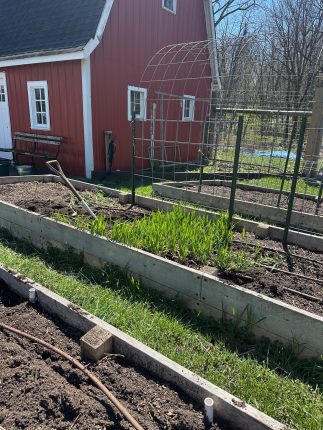
I’m not stressed about these bottom two beds because one of them will be our paste tomato bed, and they haven’t even germinated yet. (If you’re new, see my direct seeded experiment for more details!) These beds warm up the latest because they are in the lowest and shadiest part of the garden. (We always prep and plant from the top down).
Setting Up Trellises
I love to place my trellises where I want a crop to go ahead of the planting season. This gives me time to consider angles and ponder views. Growing food can and should be a beautiful endeavor, and I like to make our garden as visually appealing as they are tasty.
I’ve started taking some of the trellises out and put them into beds so I can see the future. This includes imagining my swaths of zinnia and blocks of sweet corn, too. It all has an impact on the feel of the garden. Each year takes on its own personality, while always nodding to seasons’ past in more than one way.
I’m also needing to trellis my spring pea plantings as well as get ready to trellis my first succession of bush green beans.
Orchard Pest Management
John has been spraying Cease (Bacillus subtilis, a fungicide) and Neem for a few weeks now, and has started adding in Surround (kaolin clay) to try and get a strong coating on the trees this year. These are foliar sprays that help ward off the nagging, perennial pest pressure that grows right alongside our orchard.
We continue to struggle with plum curculio and are hoping with this new method, combined with some strategic nematodes we will add later this year, will help knock the population back. Growing fruit is no joke around here!
Read about my recommended organic pesticides in this guide.
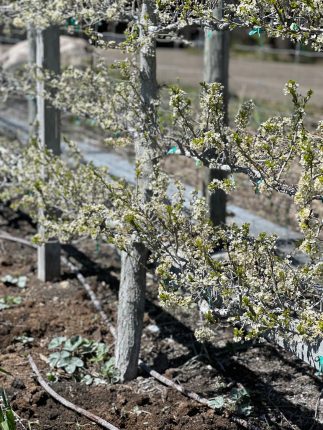
The white hue on this Black Ice plum tree is Surround, which is a natural deterrent for pests that causes them to get disoriented and uncomfortable and then, theoretically, not lay their eggs in our prized fruit! Hardening Off & Transplanting
Yes, it’s time! Be sure to take it easy with your indoor-started plants. I am finding the easiest way to ease my plants into the outdoors is to use a shade cloth for the first few days if it’s full sun. This way, you can leave them outside and not have to worry about them getting sunscald. On cloudy days, you can leave them exposed (many indoor light setups, including mine, are about the equivalent of a cloudy day …)
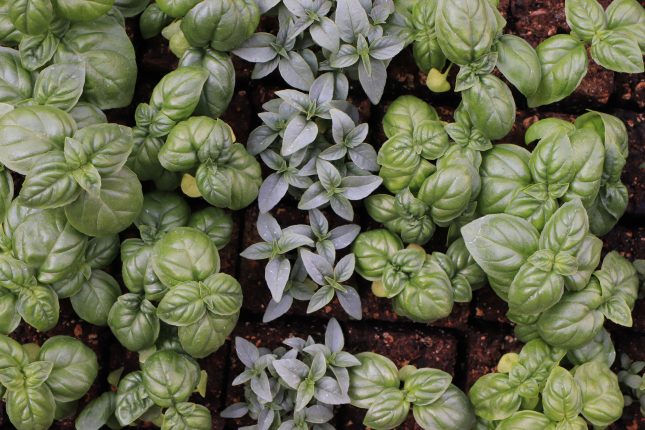
Now is a great time to start basil! I don’t start it much earlier than mid to late April through May because it won’t thrive until it’s really hot, but does take a little longer to establish than those fast growing squash and cukes! Taking the proper time to harden your seedlings off is vital to a smooth transplant. Be sure to follow my tips here. I’ve broken it down into an easy to follow set of steps.
Every indoor-started seedling needs transition time before going full-time in the blazing sunshine. We even just received 100 prairie seedlings and their instructions recommend a several-day hardening off before planting. Here’s what I’ve been hardening off ahead of transplanting right now:
- Tomatoes, peppers, and eggplants
- Onions, leeks, shallots
- Fennel
- Broccoli, cabbage, kohlrabi, bok choy, etc
- Zinnia, marigold, dahlia, gomphrena, cosmos, sesame
- Basil, thyme (not yet, but will need to be done this month)
Pest Pressure
Be on the lookout for pests this month. I now regularly see cabbage whites flying around in late April. (Yes, swear words are thrown their way when I see them.)
We are seeing a lot of pest pressure in our spring beds. I wonder if it was the mild winter or the lack of snow or the different compost I used.
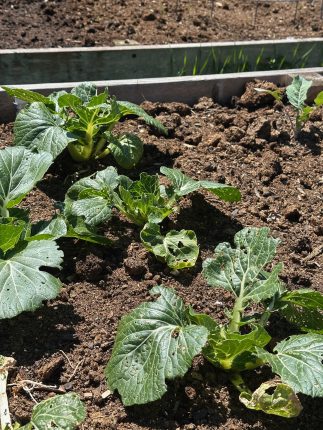
It’s an ugly mess out there! These are my chewed up bok choy, something I’ve never had an issue growing save some small flea beetle holes.
I am going on the offensive this spring and will soon order beneficial nematodes to get our flea beetle population in check. This application will also include applying nematodes to the asparagus bed, and while I’m at it I’ll treat the entire garden and buy two kinds, one that will attack caterpillar larvae which may dampen my cabbage looper population, and the other that focuses more on these soil dwelling beetles.
What to Sow Now
Last weeks for Cold Hardy Crops
This is our final call for fast-growing cold hardy crops. I will sow one more row of radishes (I’ve got 4 successions so far this spring), maybe two, over the next two consecutive weeks and then that’s it for the spring. That will give us fresh radishes to eat and share for most of May and June.
Arugula while cold tolerant can be sowed all summer. I like to transition to a slightly protected/shaded area when the heat kicks in and harvest it promptly. Boy does it go well in summer salads or in a quick weeknight crepes.
Direct Seed
- Radish*
- Salad turnips*
- Green onions
- Arugula
- Cilantro
- Bok Choy
- Broccoli
- Kohlrabi*
- Kale
- Head lettuce
- Parsnips*
- Beets
- Carrots
- Corn
- Beans
- Tomatoes (cherries or determinate paste) and Peppers (under a row cover for extra heat)
- Potatoes
- Wheat (our red fife wheat has germinated!)
* last chance to sow before the heat arrives
Indoor Sowing
- Heat tolerant lettuce (e.g. Jericho, Concept, Coastal Star)
- Cabbage for summer eating (red, green, savoy)
- Fennel (last chance, and maybe too late … I’m sowing some now so I’ll report back)
- Tomatoes (just direct seeded our determinate paste tomatoes in cold frame)
- Peanuts (in 3.25” newspaper pots)
- Brussels sprouts (first week of May)
- Celery (for fall) (now through end of May)
- Summer and winter squash
- Cucumber
- Melons (musk and watermelon)
Herbs
- Parsley
- Basil
I don’t have room to grow them but I am starting sweet potato slips again this spring from my saved sweet potatoes. Maybe I’ll squeeze one or two slips into the garden, or maybe I’ll give them away. It will take about 6 weeks to grow slips, which should time out perfectly for a June planting.
wait until Mid-May
I am not sowing any cucurbits just yet – watermelon, muskmelon, summer squash, zucchini, winter squash, and cucumbers all wait until around Mother’s Day and all get sowed into a 3.25” newspaper pot.
Lastly, I am holding off on a number of herbs, notably the ones I trialed last year and quickly learned direct seeding is likely a better route. This includes fenugreek, cumin, nigella, and mustard seed. I am thinking I will direct seed these later in May instead of indoor sowing and transplanting. And the space I want to use for this is a colder spot so will need this month to thoroughly warm the soils.

I hope this gives you lots of room to play and grow in your garden. Remember that gardening is a personal endeavor, one that is most meaningful the more personal you make it. We are now squarely in the hum and buzz of the garden. It’s our most frequented space besides the kitchen, and will be now until sometime in October! It’s good to be reunited with this dear old friend, weeds, pests, and all.
-
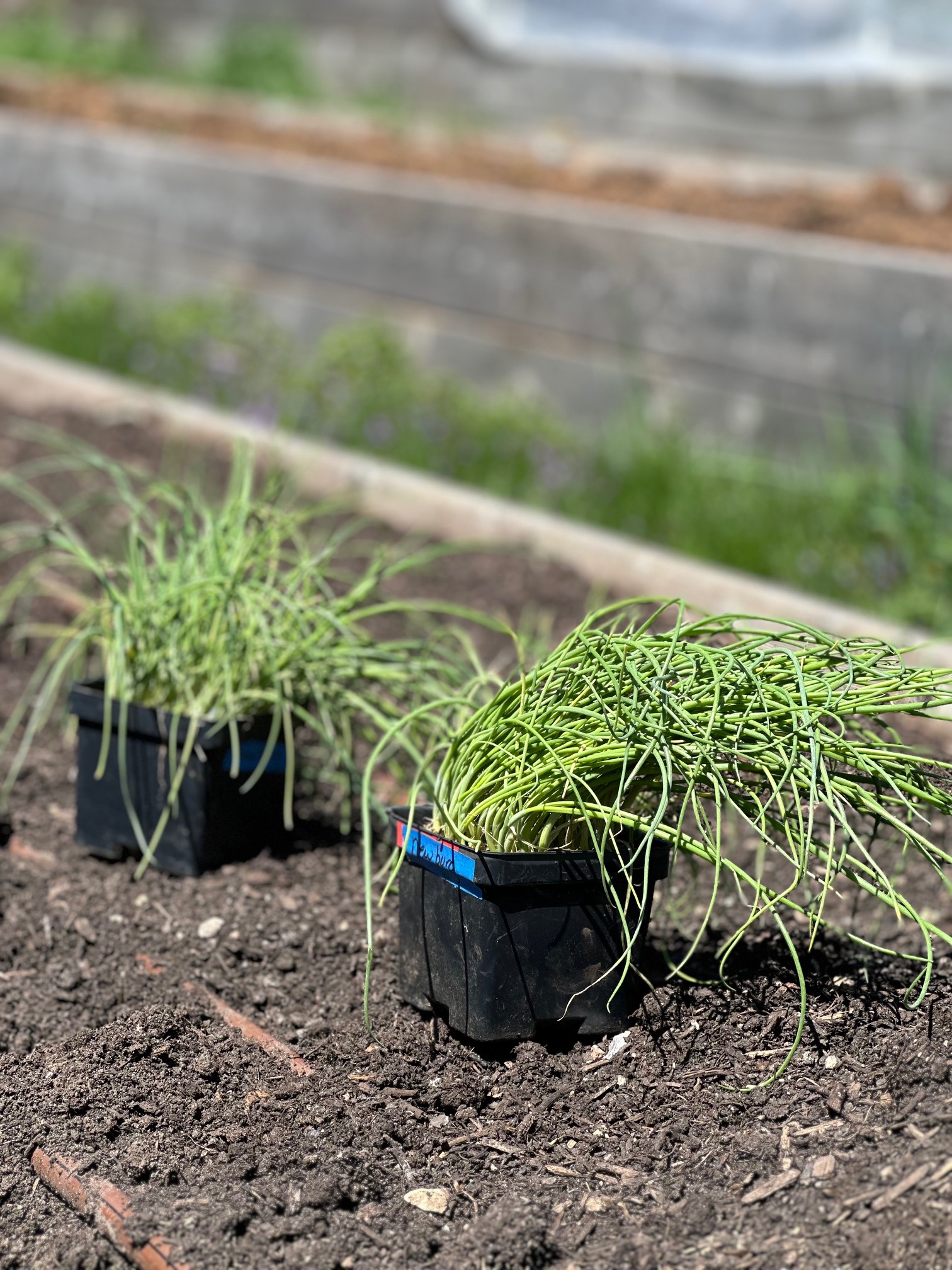
Laying out the garden
Saturday was my first full day gardening. As in, transplanting. I put about 400 onions, shallots, and leeks (total) into various beds around the garden. And in planting my onions, I set the stage for my fall beds, the space where faster roots and leafy greens will get planted in August, which, ended up being a cascade of planning ALL the beds. So this is a bonus video where I share how I’m thinking about allocating my remaining space.
-
Weekly Videos: Week of April 28, 2025
See what happened last week
This weekly video update is a part of your Seed to Fork subscription. You can always look back on previous weekly garden updates here.

